mardi 30 avril 2019

Best Android phones you can buy in the UK right now (April 2019)

Best UK phones - Backs of the Huawei P30 Pro, Google Pixel 3, and Samsung Galaxy S10

With Android thoroughly dominating the mobile industry, there are almost countless great Android smartphones to pick from in the U.K. phones market. From sleek devices that impress with premium design, to powerhouses brimming with features, to all-around great devices, and affordable phones that punch above their weight, the best Android phones in U.K. offer a staggering variety of attractive phones.

Get the best UK phone deals:

Not all smartphone models are available globally, for reasons ranging from modem and networks through to supply chains and marketing. In this roundup, we're looking at the absolute best U.K. phones for Android.

Editor's note: We will be regularly updating this list of best Android phones in U.K., as new devices launch and become available in the country.

Samsung Galaxy S10, S10 Plus, and S10e

Best UK phones - Samsung Galaxy S10 series

The most successful smartphone maker in the business today was expected to deliver great things for its marquee series' tenth anniversary. Safe to say, the Samsung Galaxy S10 series has not disappointed.

While the Galaxy Fold stole some of the spotlight, the Galaxy S10 trio is arguably Samsung's best iteration on the Galaxy S family to date. It's also the largest, with the slightly more affordable Galaxy S10e offering all the best bits of the Galaxy brand at a slightly cheaper price.

Best-in-class displays, stunning design, top-end hardware, and impressive camera performance have been hallmarks of Samsung's design for some time now. The S10 range delivers on all these fronts (mostly) and more, though the Galaxy S10 Plus is clearly the pick of the bunch thanks to its smorgasbord of features like Wireless PowerShare, an ultrasonic in-display fingerprint sensor, the larger display and battery, and depth sensor for the front-facing camera. It's also one of the only flagship phones from any OEM to still have a headphone jack.

Related: Samsung Galaxy S10, S10 Plus, and S10e specs: Memory overload

All three phones are powered by the Exynos 9820 SoC (Snapdragon 855 in other regions) paired with between 6GB to 12GB of RAM and up to 1TB of on-board storage. They also all run Android Pie out of the box with Samsung's One UI skin on top.

The Galaxy S10 Plus is the 'best' of the three, but all that flagship goodness comes with a hefty cost. The base model is 899 pounds, while the max configuration with 1TB storage and 12GB RAM is priced at a whopping 1,399 pounds. The regular Galaxy S10, meanwhile, starts at 799 pounds, and the Galaxy S10e is the most affordable of the lot at 669 pounds.

They may be expensive, but the Galaxy S10 is worth the premium.

Specs:

Samsung Galaxy S10 Plus

  • 6.4-inch Super AMOLED display with 3,040 x 1,440 resolution
  • 2.7GHz octa-core Exynos 9820 processor
  • Mali-G76 MP 12
  • 8/12GB RAM
  • 128/512GB/1TB of built-in storage, expandable via microSD card up to 512GB (uses SIM 2 slot)
  • 12MP, 12MP, and 16MP rear cameras, 10MP front-facing camera with depth sensor
  • dual-SIM (dual standby) – hybrid slot
  • 4,100mAh battery
  • Android 9.0 Pie
  • 157.6 x 74.1 x 7.8mm, 175g

Read more:


Huawei P30 Pro

best UK phones - Huawei P30 Pro back on window 2

What do you get if you take almost everything that's great about the Huawei Mate 20 Pro and tack on the most versatile camera modules ever to hit the market? You get the Huawei P30 Pro — one of best Huawei phones ever and arguably the best Chinese Android phones to date.

The main attraction with the P-series is the camera, and the P30 Pro sports the company's first quad-lens setup, once again co-engineered with Leica. The vertical module features a 40 megapixel sensor (OIS, f/1.6) main sensor based on an RYB (red, yellow, blue) model to absorb more light, 20 megapixel sensor (OIS, f/2.2) wide-angle lens, and an 8 megapixel periscope lens (OIS, f/3.4) that delivers up to 5x optical zoom and up to 10x hybrid zoom. The fourth lens is a tiny Time-of-Flight (TOF) sensor sat underneath the flash.

The results from all these camera bells and whistles — not to mention Huawei's AI advancements — are astounding. The low light shots and zoom images are stunning and represent a huge step forward for smartphone photography.

The rest of the phone is just as spectacular too. Be it the all-glass, gradient aesthetic (especially in the Aurora color), the OLED display, reverse wireless charging, the optical in-display fingerprint sensor, or great battery life, the P30 Pro goes far beyond being just a bag of camera tricks.

The Huawei P30 Pro starts at 899 pounds, which puts it on par with the Galaxy S10 Plus in the U.K..

Specs:

  • 6.47-inch Super OLED display with 2,340 x 1,440 resolution
  • 2.6GHz octa-core HiSilicon Kirin 980 processor
  • Mali-G76 720MHz GPU
  • 6/8GB RAM
  • 128/256/512GB of built-in storage, expandable via nano memory card slot (uses SIM 2 slot)
  • dual-SIM (dual standby)
  • 40MP, 20MP, 8MP, and TOF 3D quad rear cameras, 32MP front-facing camera
  • 4,200mAh battery
  • Android 9.0 Pie
  • 158 x 73.4 x 8.4mm, 192g

Read more:


Samsung Galaxy Note 9

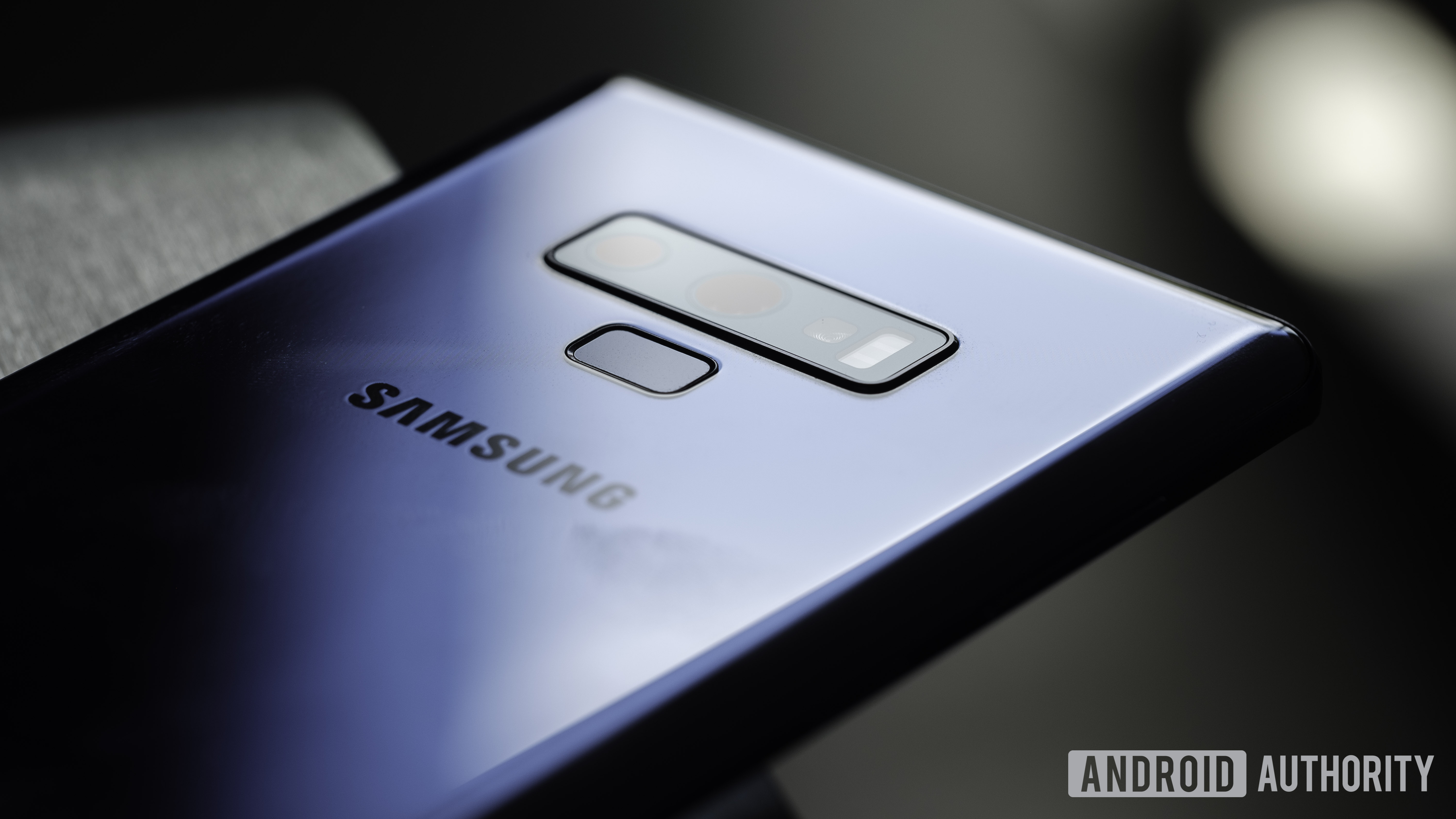
Samsung Galaxy Note 9 rear - best Android phones UK

We couldn't make a "Best Phones" list without including our overall Best of Android 2018 winner, the Samsung Galaxy Note 9. It might be expensive, but the Note 9's mighty specs and unique features form an all-round package that can't be denied.

Editor's Pick

The Note 9's sports a near-bezel-less 6.4-inch Super AMOLED display, which is a perfect pairing for the newly upgraded S-Pen with remote control support via Bluetooth. Inside you get the same Samsung Exynos 9810 SoC we saw with the Galaxy S9 in the U.K., complete with 6GG/8GB RAM and 128/512GB storage, backed by a chunky 4,000mAh battery.

It also borrows the Galaxy S9's excellent dual-lens camera suite, so top-quality photos are guaranteed. They even fixed the Note 8's dumb fingerprint sensor placement.

It may have been surpassed by the Galaxy S10 Plus in most regards, but there's still something special about the Note 9. It's also a great option for power users.

The regular Note 9 model retails for £899, while the 8GB/512GB variant pushes the price up to £1,099.

Specs:

  • 6.4-inch Super AMOLED display with 2,960 x 1,440 resolution
  • 2.7GHz octa-core Exynos 9810 processor
  • Mali-G72 MP 18
  • 6/8GB RAM
  • 128/256/512GB of built-in storage, expandable via microSD card up to 512GB (uses SIM 2 slot)
  • 12MP and 12MP rear cameras, 8MP front-facing camera
  • dual-SIM (dual standby) – hybrid slot
  • 4,000mAh battery
  • Android 8.1 Oreo
  • 161.9 x 76.4 x 8.8mm, 201g

Read more:


Google Pixel 3 and Pixel 3 XL

Google Pixel 3 and Google Pixel 3 XL in white and pink - best Android phones UK

Yes, the larger version has a massive, indefensibly ugly "bathtub" notch. Yes, they still lag behind in the specs department in some key areas, especially compared to the Galaxy S10. They're also too expensive compared to rival devices.

But, if you want a phone that takes wonderful photos every time, there's nothing that can match the Google Pixel 3 series.

While seemingly every other OEM is in a rush to make smartphones with as many lenses as possible, the big G stuck with a single shooter for its third-generation Pixel phones, instead relying on computational photography to once again give it the edge. It worked — the Pixel 3 offers the most consistent camera experience of any phone on the market, complete with Pixel-only features like the see-it-to-believe-it Night Sight mode.

Editor's Pick

Google has also managed to exorcize the display issues we saw with the Pixel 2 XL.

Both the Pixel 3 and the Pixel 3 XL sport P-OLED displays, with the former a little smaller at 5.5-inches and a lower pixel per inch total (443 ppi vs 523 ppi).

The Pixel 3 XL's QHD+ 6.3-inch is better on paper, but the harsh reality is you'll have to deal with the notch (or turn it off and live with a larger top bezel).

Aside from a slight difference in battery life, you're essentially getting the same great phone whether you go for the Pixel 3 or its larger twin. That also means you'll get the same Snapdragon 845 SoC and front facing speakers — as well as the same meager 4GB of total RAM.

Google's habit of over-inflating its prices in the U.K. also returns with the Pixel 3 series, with the entire range starting from £739. Thankfully, most other retailers (notably not Amazon, because reasons) offer better deals.

Specs:

  • 5.5-inch AMOLED display with 2,160 x 1,080 resolution (Pixel 3)
  • 6.3-inch AMOLED display with 2,960 x 1,440 resolution (Pixel 3 XL)
  • 2.5GHz octa-core Qualcomm Snapdragon 845 processor
  • Adreno 630 GPU
  • 4GB RAM
  • 64/128GB built-in storage, not expandable
  • 12.2MP rear camera, dual 8MP front-facing cameras
  • 2,915mAh battery (Pixel 3)
  • 3,430mAh battery (Pixel 3 XL)
  • Android 9.0 Pie
  • 145.6 x 68.2 x 7.9mm, 148g (Pixel 3)
  • 158 x 76.7 x 7.9mm, 184g (Pixel 3 XL)

Read more:


Huawei Mate 20 Pro

Huawei Mate 20 Pro triple camera - best Android phones UK

If you're not fussed by the P30 Pro's awesome camera but want a feature-packed, super-sized Huawei handset then the Mate 20 Pro just might be the phone for you.

The Mate 20 Pro is powered by the Kirin 980 SoC, 6GB of RAM, 128GB of storage (expandable), and a huge 4,200mAh cell. As well as a gorgeous 6.39-inch OLED display, the Mate 20 Pro also features an in-display fingerprint scanner, 3D facial recognition, and reverse wireless charging. Like the P20 Pro before it, the Mate 20 Pro also sports three cameras on the rear – a primary 40MP lens with a f/1.8 aperture, a telephoto 8MP shooter with a f/2.4 aperture and OIS, and a 20MP ultra-wide lens with a f/2.2 aperture.

Related: Google Pixel 3 Night Sight vs Huawei Mate 20 Pro Night Mode

If you want to save a few pennies, the regular Mate 20 ditches OLED for an IPS LCD display, the in-display fingerprint sensor for a physical one, and loses reverse charging, but aside from a drop in megapixels in the camera department, it's mostly the same phone with blistering performance and a much smaller notch to boot.

These phones are not cheap, however. In the U.K., you can get the Mate 20 Pro at Amazon for a whopping £899, while the Mate 20 is priced a little lower at £699 without a contract. Other retailers that sell U.K. phones like Carphone Warehouse, John Lewis, Argos, and Clove Technology are also selling the phones for similar prices. The Emerald Green version is exclusive to Carphone Warehouse, but you can grab the Black or Twilight colorways from whichever retailer is offering the best deal.

As for the rest of the Mate 20 series, you can buy the enormous, gaming-focused Mate 20 X from Amazon for £799, while the slightly underwhelming Mate 20 Lite goes for as low as £279.

Specs:

Huawei Mate 20 Pro

  • 6.39-inch Super OLED display with 3,120 x 1,440 resolution
  • 2.6GHz octa-core HiSilicon Kirin 980 processor
  • Mali-G76 720MHz GPU
  • 6/8GB RAM
  • 128/256GB of built-in storage, expandable via nano memory card slot (uses SIM 2 slot)
  • dual-SIM (dual standby)
  • 40MP, 20MP, and 8MP triple rear cameras, 24MP front-facing camera
  • 4,200mAh battery
  • Android 9.0 Pie
  • 157.8 x 72.3 x 8.6mm, 189g

Read More:


OnePlus 6T

OnePlus 6T display - best Android phones UK

The OnePlus 7 is nearly here, but the Chinese brand's latest T series phone — the OnePlus 6T — is still a superb choice.

Features include an in-display fingerprint sensor, a larger battery, and a slightly chunkier design. It also has a much smaller "waterdrop" notch, which still won't assuage die-hard notch haters, but looks much better than a larger, rectangular cutout.

Editor's Pick

The 6T is mostly a step up from its predecessor, the OnePlus 6, but one change really disappointed fans.

The reasoning behind the headphone jack's removal is pretty shaky, but OnePlus isn't the first and certainly won't be the last OEM to drop the 3.5mm port.

With similar specs, software, and an identical camera, there's no a huge incentive to upgrade to the OnePlus 6T if you already have a OnePlus 6. For anyone looking for bargain, however, the OnePlus 6T isn't just one of the best U.K. phones — it's one of the best value phones full stop.

The OnePlus 6T starts at £499 for the 6GB RAM/128GB storage model. You can bump up the RAM count to 8GB for an extra £29, or go all out for 8GB RAM/256 ROM for a total of £579.

Specs

  • 6.4-inch AMOLED display with 2,340 x 1,080 resolution
  • 2.8GHz octa-core Qualcomm Snapdragon 845 processor
  • Adreno 630 GPU
  • 6/8GB RAM
  • 64/128GB built-in storage, not expandable
  • 16MP and 20MP dual rear cameras, 16MP front-facing camera
  • 3,700mAh battery
  • Android 9.0 Pie
  • 157.5 x 74.8 x 8.2mm, 185g

Read more


Honor View 20

Honor View 20 rear - best Android phones UK

Honor has been pumping out incredible value phones with flagship specs and features for years and has already built a solid reputation in the U.K. That continues with the Honor View 20 — and then some.

The Honor View 20 is a sublime phone with a gorgeous V-pattern design, a vibrant 6.4-inch 19.25:9 LCD display, a meaty 4,000mAh battery, and a Sony-made 48 megapixel rear camera with f/1.8 aperture paired with a 3D TOF sensor. That's all powered by Huawei's latest Kirin 980 SoC and backed by either 6GB or 8GB of RAM. It even has a headphone jack and an IR blaster!

More: Specs comparison: Honor View 20 vs Honor View 10

The other big win for the Honor View 20 is the lack of a notch. Instead, Honor has opted to stick with a near bezel-less design but shift the selfie camera inside the display. This "hole-punch" design looks set to be a trend in 2019, but Honor will have always got there first.

There are some downsides — the lack of an IP rating for waterproofing, no wireless charging, and Magic UI being a little too iPhone-like for some — but at just £499 for the 6GB RAM/128GB ROM model, the View 20 is an enticing alternative to the OnePlus 6T.

Specs

  • 6.4-inch IPS LCD display with 2,310 x 1,080 resolution
  • 2.6GHz octa-core HiSilicon Kirin 980 processor
  • Mali-G76 720MHz GPU
  • 6/8GB RAM
  • 128/256GB built-in storage, not expandable
  • 48MP and TOF 3D stereo camera, 25MP front-facing camera
  • 4,000mAh battery
  • Android 9.0 Pie
  • 156.9 x 75.4 x 8.1mm, 180g

Read more


Xiaomi Pocophone F1

Pocophone F1 front - best Android phones UK

Want all the power of a £1,000 flagship phone for less than a third of the price? Look no further than the Pocophone F1 — the best budget U.K. phone by a country mile.

When Xiaomi officially launched in the U.K. in 2018, it brought with it the first phone from its Pocophone sub-brand, which immediately overshadowed the rest of Xiaomi's phones.

Starting at just £329 (and going as low as £279 in frequent sales), the Pocophone F1 offers a frankly bonkers price-performance ratio. It's powered by the same Qualcomm Snapdragon 845 SoC that featured in almost all the biggest flagship phones of 2018 and is backed by 6GB of RAM. It even went toe-to-toe with the big boys in our Best of Android testing.

Related: Xiaomi Mi 8 Pro vs Pocophone F1: Which is better value?

It's not just the silicon that belies the phone's price tag either. The 6.18-inch LCD display and 4,000mAh battery are both far above anything else in the low-to-mid-tier market.

Of course, there are sacrifices to be made to get those features at this price point. The most obvious one is the dual-lens camera, which, while by no means terrible, won't produce the kind of results you'd expect from other Snapdragon 845 phones. Xiaomi's MIUI skin is also a little hit-and-miss, even with the new features added specifically for the Poco Launcher, and the overall design is a little bland.

However, if you want a phone that'll go hard, all day, and still have a bundle of cash left over, the Pocophone F1 is absolutely one of the best U.K. phones.

Specs

  • 6.18-inch IPS LCD display with 2,246 x 1,080 resolution
  • 2.8GHz octa-core Qualcomm Snapdragon 845 processor
  • Adreno 630 GPU
  • 6 RAM
  • 64/128GB of built-in storage, expandable via microSD up to 256GB (uses SIM 2 slot)
  • 12MP and 5MP rear cameras, 20MP front-facing camera
  • dual-SIM (dual standby) – hybrid slot
  • 4,000mAh battery
  • Android 8.1 Oreo
  • 155.5 x 75.3 x 8.8mm, 180g

Read more:


Best UK phones – Check out our related guides:

Looking for something more specific than the best Android phones in U.K.? Maybe the best cheap phone, a dual-SIM phone, or something specific to your carrier? No matter what you're looking for, we have you covered.

That's it for our look at the best Android phones in U.K.. Sound off in the comments on your opinions for U.K. phones.

Affiliate disclosure: We may receive compensation in connection with your purchase of products via links on this page. The compensation received will never influence the content, topics or posts made in this blog. See our disclosure policy for more details.


from Android Authority http://bit.ly/2GcDukb
via IFTTT

Samsung Galaxy Note 9 update hub: Note 9 gets April security patches, camera tweak

Samsung Galaxy Note 9 update

Update, April 30, 11:42 a.m. ET: Samsung Galaxy Note 9 update hub: Samsung is rolling out the April Android security patches to the Galaxy Note 9 along with some other minor tweaks. The update is landing in Germany, according to an article published on Sam Mobile earlier today, though it looks like it may be hitting the Netherlands too.

The update comes in at around 520MB and it gives users the ability to set a schedule for its Night viewing mode, and to alter the field of view when taking selfies. You can now choose between 68 and 80 degrees when using the selfie camera thanks to a new toggle above the shutter button. One user also suggests the same can be achieved by swiping left or right on the viewfinder.

Some U.S. carriers also rolled out the April security patches this month, but without mention of the other tweaks. If you received the patch in the U.S., check your Night mode settings and your selfie camera to see you received the other upgrades with it. If not, they should follow in a future OTA.

Original coverage, March 2, 07:57 a.m. ET: Welcome to the Samsung Galaxy Note 9 Android update hub. Here, you'll find everything you need to know about the latest Galaxy Note 9 updates, including its current version, and when future updates are likely to arrive.

Galaxy Note 9 update

  • Current stable version: Android Pie
  • When will the Galaxy Note 9 get Android Q? March – April 2020 (estimated)

The Galaxy Note 9 arrived with Android Oreo on August 24. It started to receive Android Pie, the latest version of Android, in February. Android Q is expected to be the last major software update it receives.

Based on Samsung's recent updates, the phones should receive Android Q within seven to eight months of Google releasing the final version (Google is expected to release Android Q around this August). This would represent roughly the same timescales as we saw with the Galaxy Note 8, which launched with Android Nougat, receiving the Android Pie update. We'll let you know when we learn more.

Samsung Galaxy Note 9 update availability Android Pie Android Q
AT&T Yes TBA
Sprint Yes TBA
T-Mobile Yes TBA
Verizon Yes TBA
U.S. unlocked Yes TBA
International unlocked Yes TBA

Let us know which Galaxy Note 9 update you're rocking in the comments, and if you've spotted an OTA we haven't, tip us!

Looking for another device update? Head to our general Android Pie update tracker at the link.


from Android Authority http://bit.ly/2XS4qva
via IFTTT

Samsung losing more ground in India while Vivo gobbles it up

Samsung Logo from CES FirstLook 2018-1

Samsung lost its top spot in India to Xiaomi a little over a year ago now (whether Samsung wants to admit it or not). Although there doesn't appear to be any chance in the near future of the company losing its second-place slot, the latest smartphone shipment estimates paint a bleak picture for the South Korean electronics giant.

According to Canalys, Samsung shipped 7.3 million smartphones in India during the first quarter of 2019. That's a small (but significant) drop of 200,000 units as compared to the first quarter of 2018.

Editor's Pick

Of the top four Indian smartphone vendors — Xiaomi, Samsung, Vivo, and Oppo, in that order — Samsung is the only brand to ship fewer smartphones in the country year-over-year.

To make matters worse, Samsung also lost Indian market share this past quarter by a little less than one percent.

Samsung's troubles in India reflect the company's woes throughout the rest of the world, so these results aren't too surprising. However, India is a very important market for all smartphone vendors as its one of the few markets that's still growing, making it an opportunity for revenue. Samsung's share shrinking is definitely bad news.

Canalys

It wasn't all dour news in India, though. Number one vendor Xiaomi grew its market share by four percent and shipped 400,000 more smartphones than it did the previous year. The overall India market also grew by just under two percent — not an excessive amount of growth, but growth nonetheless.

Editor's Pick

The real star of India right now, though, is Vivo. According to Canalys, Vivo shipped 2.4 million more smartphones in India as compared to Q1 2018, a growth of over 100 percent. This increased its market share from 7.3 percent to 15 percent, handily securing its third-place slot on the leaderboard.

Also, the young company Realme — itself an offshoot of Oppo — made significant gains shipping 1.3 million units. We can't compare that number to Q1 2018 because the company wasn't active then, which is pretty impressive growth.

You can read the full report from Canalys here.

NEXT: Report: Chinese smartphones are dominating in India, but so are Indian feature phones


from Android Authority http://bit.ly/2Jb95Ee
via IFTTT

Energizer’s 18,000mAh phone is an Indiegogo disaster

The Energizer P18K Pop.

  • The Energizer P18K Pop, offering an 18,000mAh battery, has fallen short of its Indiegogo goal.
  • Avenir Telecom's smartphone only managed to hit roughly one percent of its target.
  • It might be the thickest smartphone we've ever seen due to the massive battery.

The Energizer P18K Pop caught our eye at MWC 2019, owing to its gigantic battery and comical proportions. Unfortunately, the phone's IndieGogo campaign failed by a massive margin.

The IndieGogo campaign, launched by Energizer brand licensee Avenir Telecom, had a $1.2 million goal. It only managed to hit $15,005, or just over one percent of its goal, according to The Verge. More specifically, the campaign only had 11 backers. To put that in perspective, it had fewer backers than the pricey Meizu Zero port-less phone.

The Energizer P18K Pop.

The Energizer P18K Pop offered a pop-up selfie camera mechanism (with a 16MP+2MP pairing), a 12MP+5MP+2MP triple rear camera trio, a Helio P70 chipset, 6GB of RAM, and 128GB of storage. The star of the show was an 18,000mAh battery though, taking up to nine hours to fully charge. The battery is also responsible for the incredibly thick design (which bizarrely lacks a 3.5mm port as well).

It's a little disappointing to see the campaign fail, as it's always refreshing to see something different. There seems to be demand for bigger batteries from some consumers, even if it means the phone has to be a little thicker. Unfortunately for Avenir, users seem to agree that the power bank-sized phone was a step too far.

Editor's Pick

Then there was the asking price, as the Energizer P18K Pop had an early bird price of $549 (normally $699). Chinese brands like BlackView and Oukitel offer 10,000mAh+ phones at a much cheaper price tag. Sure, these devices don't have an 18,000mAh battery or pop-up selfie camera, but you've still got a long-lasting phone with juice to spare for other gadgets.

We've contacted Avenir Telecom to find out whether the P18K Pop will still see the light of day. But a company statement on Indiegogo suggests that it could yet see a release.

"Although it didn't reach its goal, we will work on further improvement on the P18K (design, thickness, etc.) as we do believe there is a rising interest for smartphones with incredible battery life, which can also be used as power banks," read an excerpt of the statement.

NEXT: How to download images from Instagram — Android and PC


from Android Authority http://bit.ly/2GRwqcK
via IFTTT

Deal: 7 web development kits for less than the price of 1

Web developmentFor most of us, $29 isn't going to break the bank. If you've got an interest in web development and a bit of drive to learn some handy new skills, it could be life-changing.

That's the price that the Complete PHP and MySQL Web Development Bundle has been slashed to today. This combination of seven online training kits and 44 hours of expert instruction is enough to take you from an absolute beginner to web dev guru by the time you're done.

I mean, if you consider that a supercomputer or AI-driven machine could be doing your job in 10 or 20 years time, what will you be doing?

The people who will still have lucrative jobs will be in IT and web development. If you can build high-functioning websites, you're future-proof.

The PHP and MySQL Complete Web Development Bundle

PHP and MySQL are two important tools used in web development, allowing you to create interactive content that integrates with databases to manage large amounts of data.

Across this set of learning kits, you'll specialize in these useful applications, as well as frameworks which take them to the next level such as Yii and Laravel. Don't worry, the web lingo will all make sense pretty quickly.

The full web development bundle:

44 hours of specialist training is bound to be pricey, but they occasionally drop the price massively to generate interest. That's the case for the next day or two, with the whole $2,100 bundle being offered for just $29.

That gets you lifetime access too, so don't worry if you're a bit snowed under. You can take advantage of this 98 percent price drop now then learn at your own pace when ready.

We don't know when this bundle will be on offer again, so don't miss this opportunity. Hit the button below to find the deal.

The AAPicks team writes about things we think you'll like, and we may see a share of revenue from any purchases made through affiliate links. To see all our hottest deals, head over to the AAPICKS HUB.


from Android Authority http://bit.ly/2GKHlUs
via IFTTT

11 things you need to know in tech today

Here's your daily tech digest, by way of the DGiT Daily newsletter, for Tuesday, April 30, 2019!

Like what you're reading? Then you can also subscribe and get the newsletter sent directly to your inbox — check out the box at the bottom of the page.

1. Google's Pixel pressure

Google Pixel 3 XL vs Pixel 3

Google's parent Alphabet reported earnings yesterday and while Google is doing very, very well, growth wasn't as strong as predicted.

A brief look at the numbers before we talk Pixel, just because it's amazing how extraordinary numbers can become so ordinary:

  • Alphabet reported a net income aka profit of $6.6 billion on $36.33 billion in revenue for the first three months of 2019.
  • That's 17% more revenue when compared to the same first three months in 2018.
  • The company now has close to or around 100k staff.
  • But the signs are that Google's advertising business can't keep growing as fast as it has, reaching a saturation point.
  • That leaves growth for Google to be found elsewhere.
  • And on that point, the company's "Other Bets," which include ideas and companies like self-driving Waymo and Project Loon internet balloons, are expensive. Those efforts lost $868 million, or nearly $300m a month. Betting on big ideas costs money.
  • So what about Google's hardware, from the Google Home to the Pixel, and so on?

Google's hardware division:

  • First, it emerged that Pixel smartphones aren't selling well, despite the launch of the Pixel 3.
  • Alphabet CFO Ruth Porat noted the decline on the company's earnings call.
  • Sales were already miserly.
  • Sundar Pichai, Google's CEO, was on the defensive about its hardware investments, talking up the Google Home smart speaker as a "market leader" and that "our commitment is very strong".
  • More detail was given by CFO Porat, "hardware results reflect lower Year-on-Year sales of Pixel reflecting in part heavy promotional activity industry-wide given some of the recent pressures in the premium smartphone market."

What does that mean exactly?

  • I'm not sure. Two "reflections" in one sentence is difficult to parse.
  • It looks like Google is saying: expensive smartphones aren't selling as rapidly as in the past – even Apple can't sell as many iPhones and no longer reports details.
  • Last night revealed Samsung made a lot less in Q1 too, although that was expected, and the Samsung Galaxy S10 sold well enough through marketing efforts (The Verge).
  • So, competitors have spent big on marketing, which has squeezed out the Pixel line.
  • And that would echo what we know: the flagship market is the toughest it ever has been. High-end phones from a year or two ago last longer, still perform well, people aren't upgrading as rapidly because new phones cost more than ever, and new devices don't pack enough must-have features.
  • You can listen in to the entire earnings call or just tap here for the moment at 7:51 when Porat mentions the Pixel issues, and see what you can decipher.

A remedy?

  • We've argued in the past that Google probably doesn't even want market share from its Pixel line. Google just can't be this bad at selling smartphones.
  • Pixels seem to exist as a platform for Google software, including its Pixel camera, rather than truly excellent hardware. They're still expensive, they're still not widely sold – only available on one carrier in the US.
  • It's an expensive flagship that seems more like a hobby for Google.
  • The fix isn't impossible: better hardware, better value, but only if Google wants to do so.
  • That might all change at Google I/O this year. Google confirmed last night it will make a hardware announcement.
  • Finally, we might see something different, and potentially aggressive?
  • Most expect the Google Pixel 3a and 3a XL: more budget-friendly devices with the same excellent camera.
  • Will that be enough?

2. "I spent a week with a $17 phone – here's what I learned" (Android Authority).


3. The once-hot cute robotics startup Anki is shutting down after raising more than $200 million (Recode).


4. Vodafone found hidden backdoors in Huawei equipment back in 2011 and 2012, no evidence of data compromise though (Bloomberg).


5. OnePlus ad in NYT references that U2/Apple iTunes thing for some reason (AA).


6. Tesla is finding out what it's like when China gets a little angry (Business Insider).


7. "Apple, enough with the slow-ass chargers" (Gizmodo).


8. The cameras YouTubers love: Video creators are using everything from Sony's A7 III to RED's Monstro 8K (Engadget).


9. Tame white Beluga whale with harness could be Russian weapon, say Norwegian experts (The Guardian).


10. Enough with the 'Actually, electric cars pollute more' bullsh-t already (Jalopnik).


11. "What felt like a useless piece of advice until you actually tried it?" (r/askreddit). (This blew my mind: "If you have a clogged nose, doing 8-10 pushups will temporarily clear it up.")


DGiT Daily: Your Tech Resource

Dgit Daily is powered by our sister site dgit.com

Visit dgit Daily

Finally, a tech subscription worth reading.

Sign up for daily digests of the tech content most relevant to you.
By signing up, you agree to our Privacy Policy and European users agree to the data transfer policy.

In case you don't know, the DGiT Daily delivers a daily email that keeps you ahead of the curve for all tech news, opinions, and links to what's going down in the planet's most important field. You get all the context and insight you need, and all with a touch of fun, and the daily fun element that you otherwise miss.


from Android Authority http://bit.ly/2IRCynn
via IFTTT

LG G8 ThinQ Hand ID and Air Motion – How do they work?

LG G8 ThinQ

The LG G8 ThinQ has powerful specs and a beautiful design, but so do many other smartphones. Some argue the phone doesn't do much to stand out, something we agreed with in our LG G8 ThinQ full review. That's not the full story though, the phone does have a handful of cool features that often get overlooked. Two of the most interesting features are Hand ID and Air Motion, which allow you to unlock and control your smartphone without touching it.

Interested? Stick around and find out what makes these the coolest innovations coming from the LG G8 ThinQ. They will prove to be helpful when your hands are dirty or you find yourself multi-tasking.


What makes Hand ID and Air Motion work?

Both features are powered by the ToF (time-of-flight) camera and the infrared sensor located in the front of the device. In unison these sensors have the ability to read your blood. More specifically, they can map out the veins in your hand.

LG G8 ThinQ Review with hidden notch

In Hand ID, this makes for a very secure way of unlocking your smartphone. We all have unique hand vein patterns and it is claimed that this method is nearly impossible to spoof or fake.

Of course, being able to recognize vein patterns in the hand also helps the LG G8 ThinQ capture movement, which allows for Air Motion gestures.


How to use Hand ID

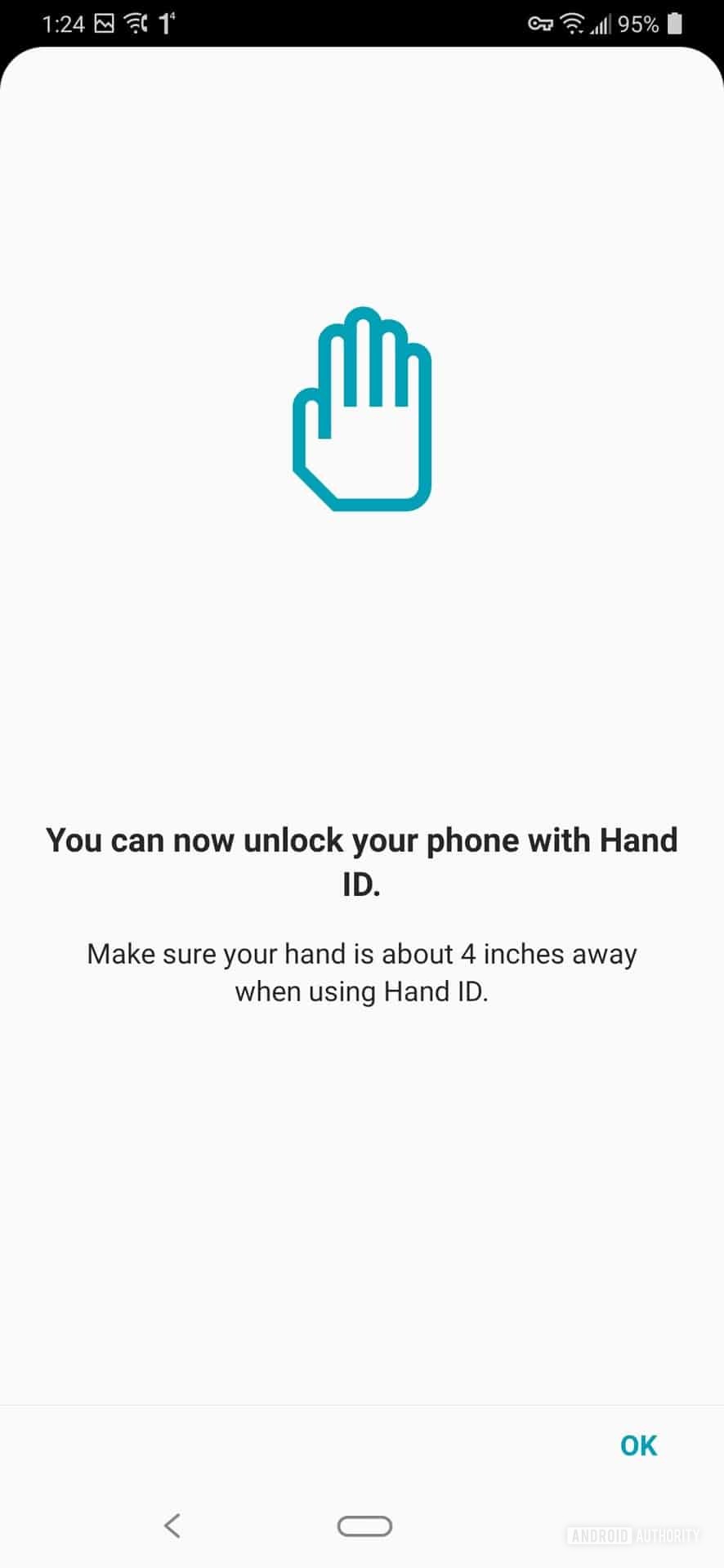
Hand ID is simply another form of biometric authentication for your smartphone. Simply head over to the settings, activate the feature and register your hand. After this you will be able to unlock your device by simply floating your palm over it.

  • Open the Settings app.
  • Go to the "General" tab.
  • Select "Lock screen & security".
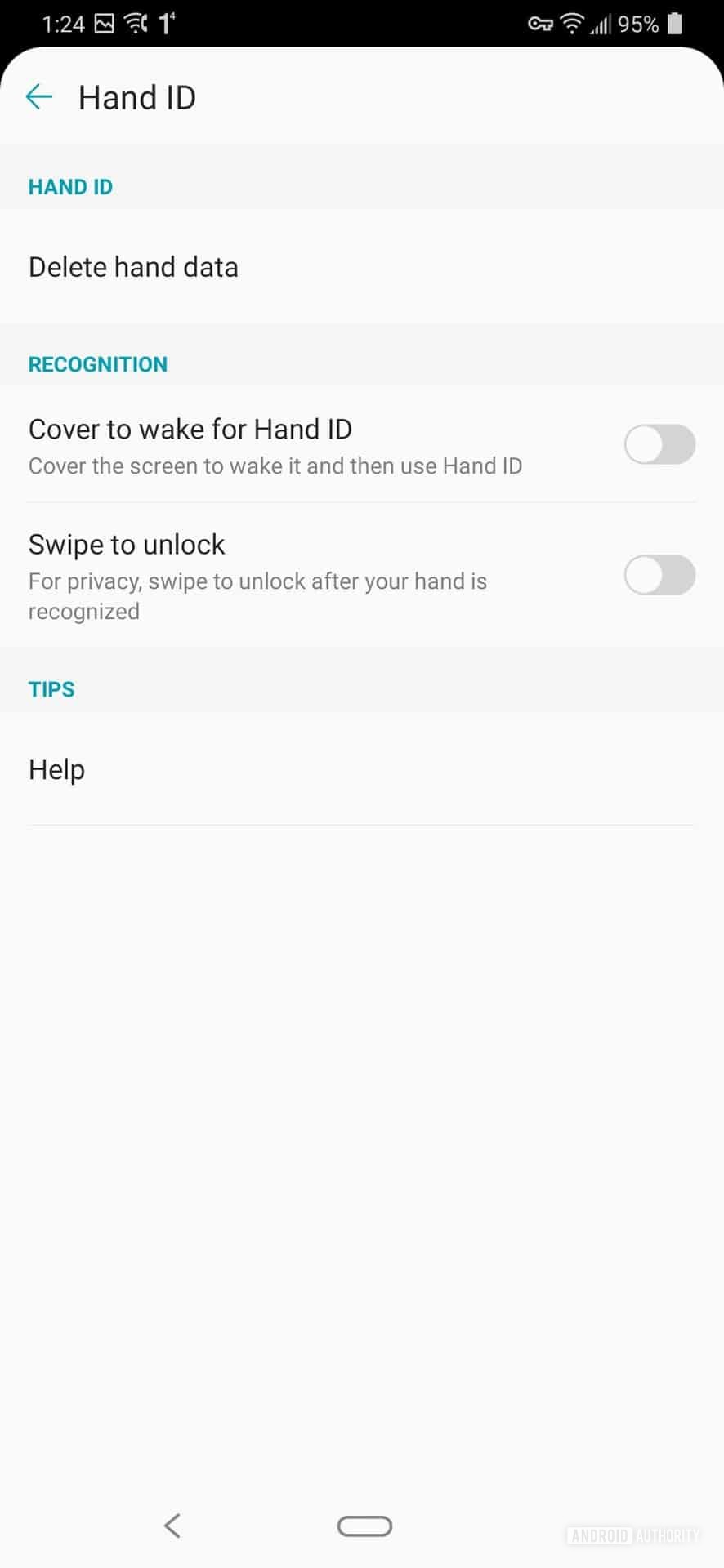
  • Scroll down to the Biometrics section and select "Hand ID".
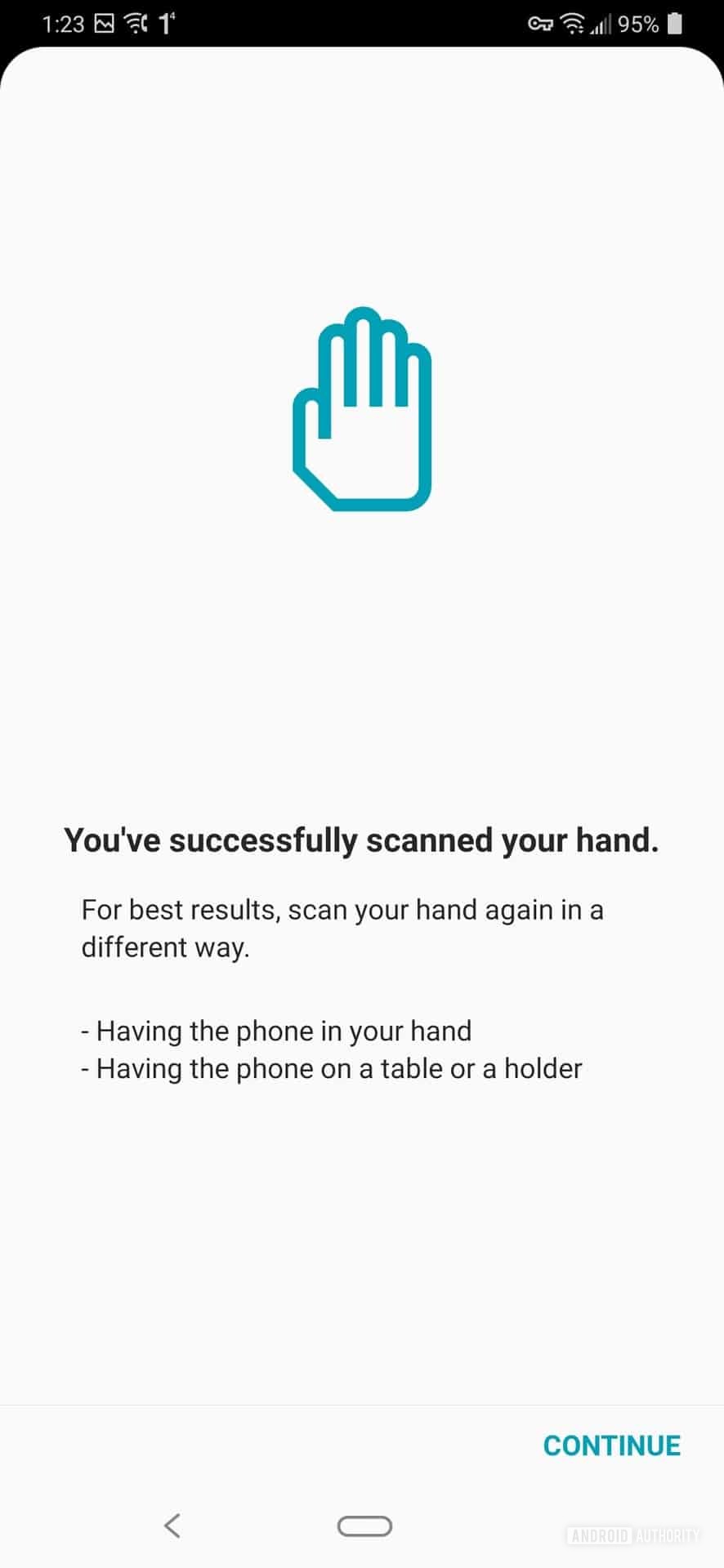
  • Follow instructions to register your hand data.
  • You can turn on a couple of recognition features: "Cover to wake" and "Swipe to unlock".
  • Turn the screen off and on.
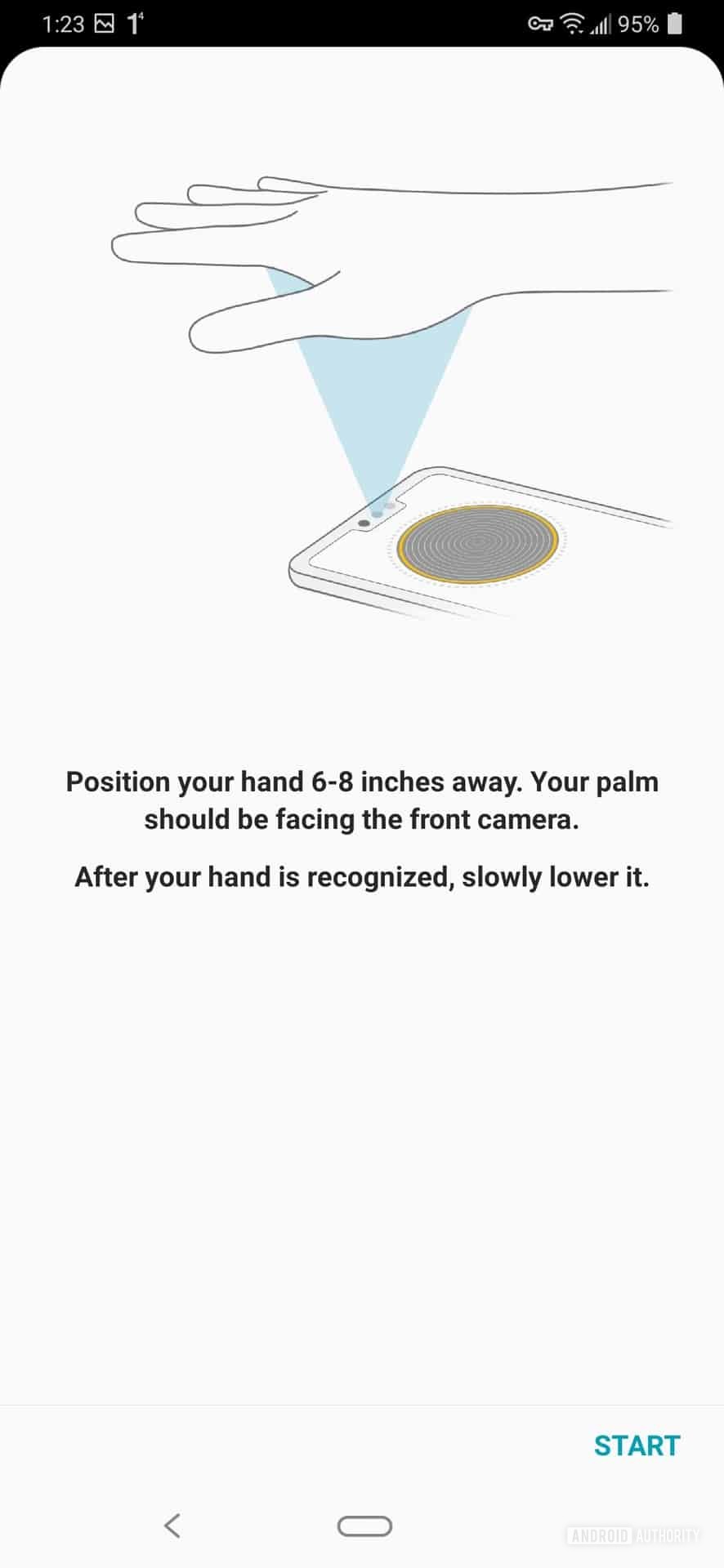
  • Put your palm 6-8 inches from the front-facing camera to test.
  • Your phone should unlock!

I like to use "Cover to wake", just because it makes no sense to me to have to actually touch the phone to turn it on and then go ahead and unlock without touching. With this feature on you can just cover the front of the device with your palm to activate Hand ID. Then simply raise your palm to the desired height and let the phone read your veins.

Swipe to unlock simply forces you to swipe the screen up after unlocking your device with Hand ID. If turned off, you will be sent directly to your home screen after your palm is read.


How to use Air Motion

Air Motion gets a bit more interesting, as it is LG's way of helping you interact with the phone without actually touching it. The feature works best when the phone is static, which is often the case when it is sitting on a table or dock.

Here's how to activate Air Motion:

  • Open the Settings app.
  • Hit the "General" tab.
  • Select "Air Motion".
  • Toggle on functions you wish to use Air Motion for. I have turned them all on, just to have the options available. After all, you don't have to use them. More info on each function will be detailed below.
  • Turn on the "Show hand guide" feature to have the phone demonstrate when it has recognized your hand.

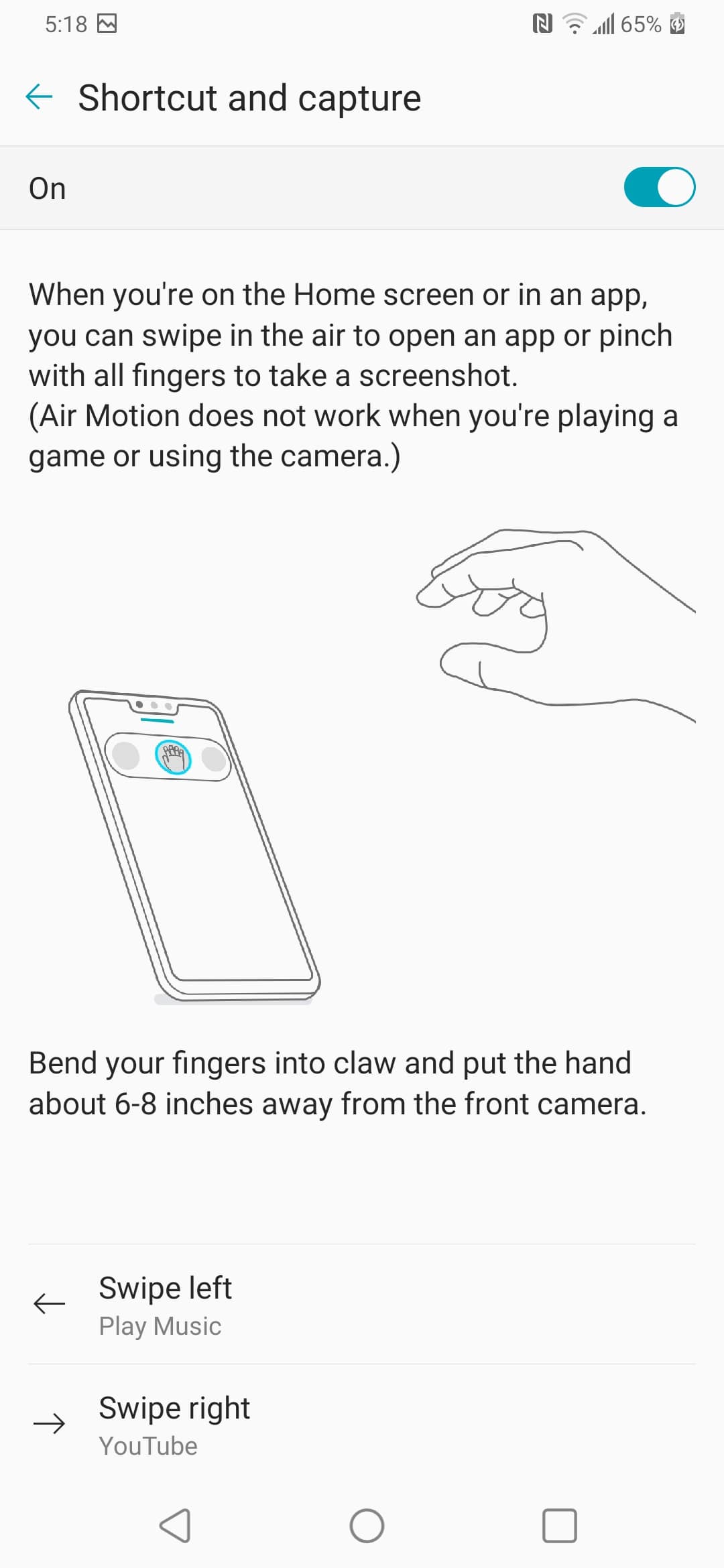
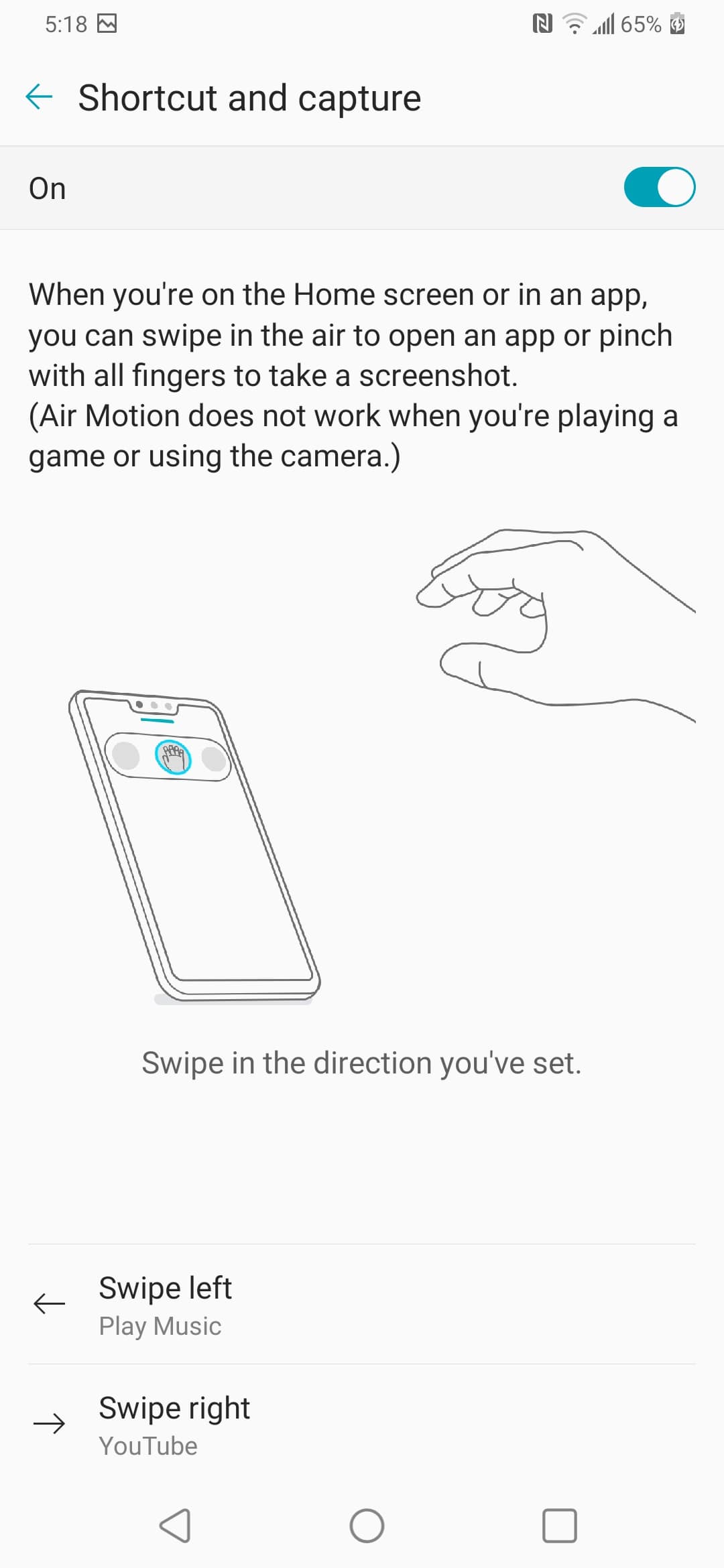
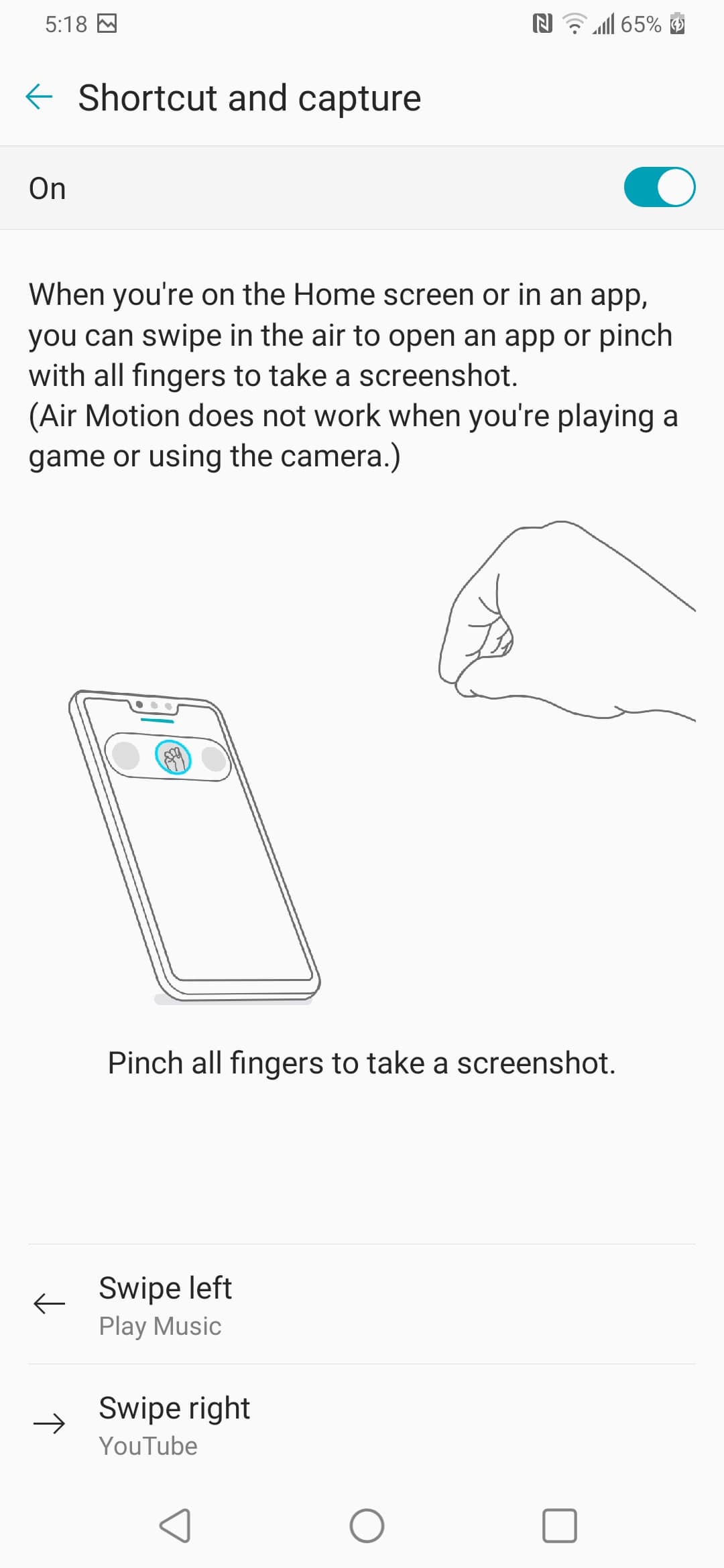
Shortcut and capture

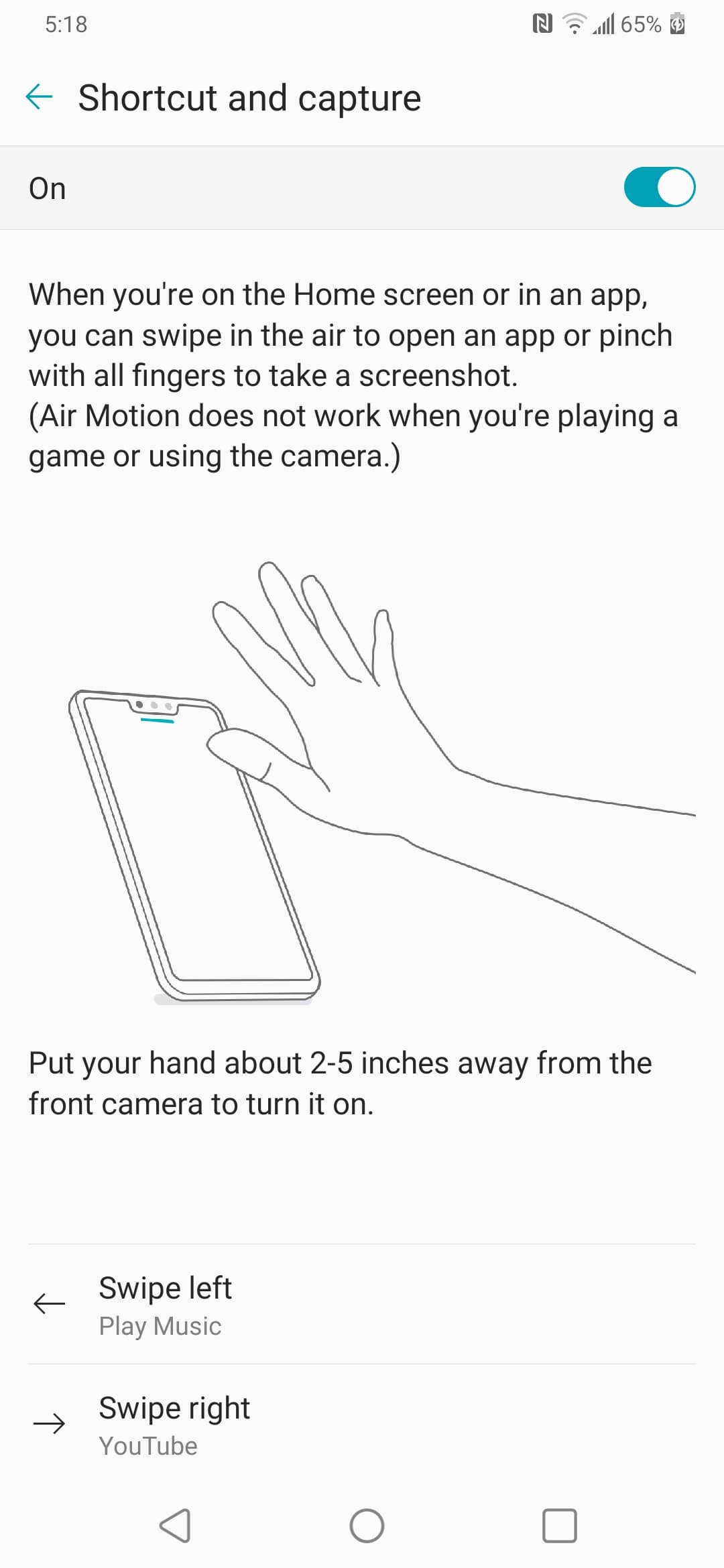
This makes it possible to use Air Motion to launch an app or take a screenshot.

  • Open the Settings app.
  • Hit the "General" tab.
  • Select "Air Motion".
  • Toggle "Shortcut and capture" on.
  • Hit "Shortcut and capture" to access its dedicated options.
  • In the bottom select which apps you would like to create Air Motion shortcuts for.
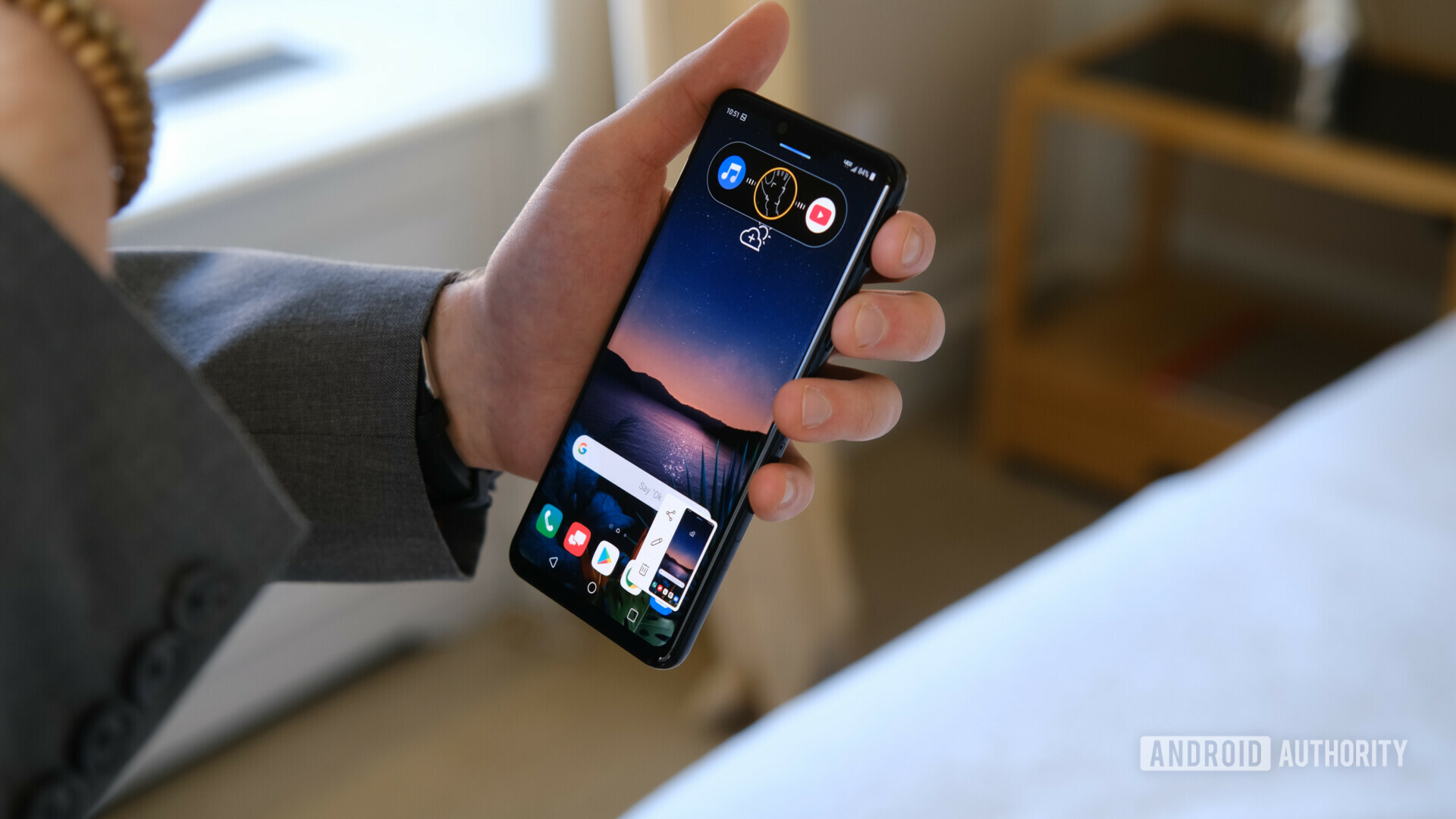
  • Once set up, simply put your hand 2-5 inches over the front sensors. Your hand will be recognized and a light bar will show up right under the notch.
  • Pull your hand away until it is 6-8 inches from the sensors and form a claw with your fingers.
  • You can move your hand in the direction of the app you want to launch.
  • Alternatively, you can pinch your fingers to take a screenshot.

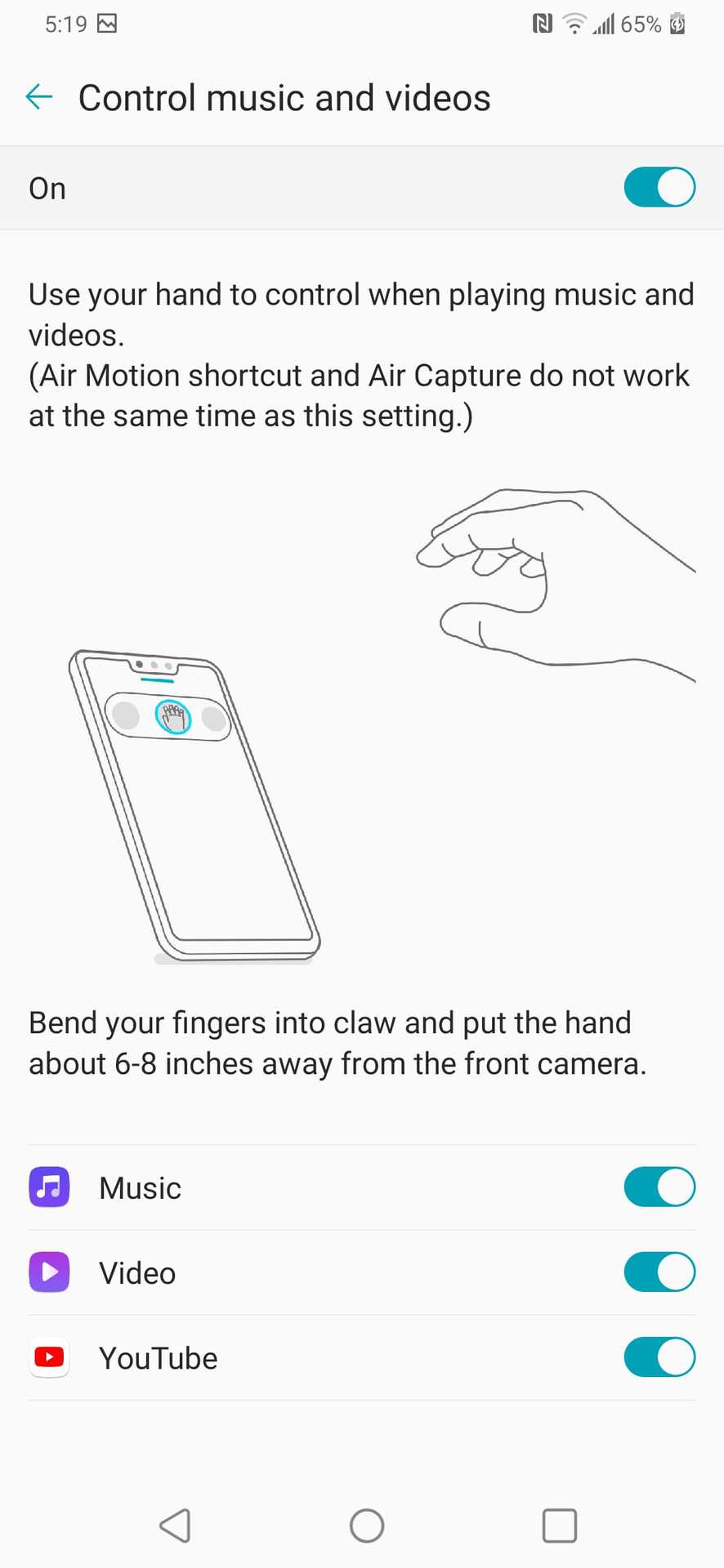
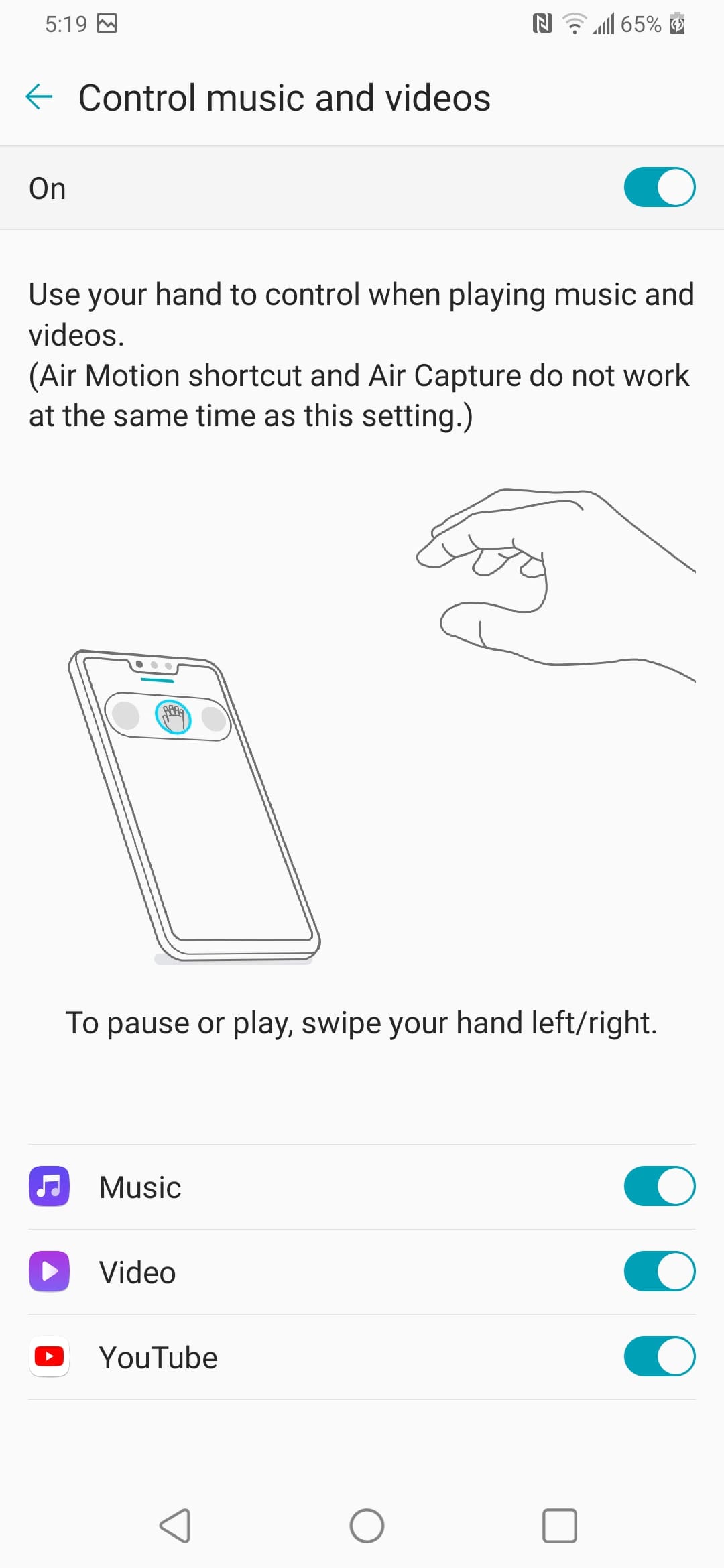
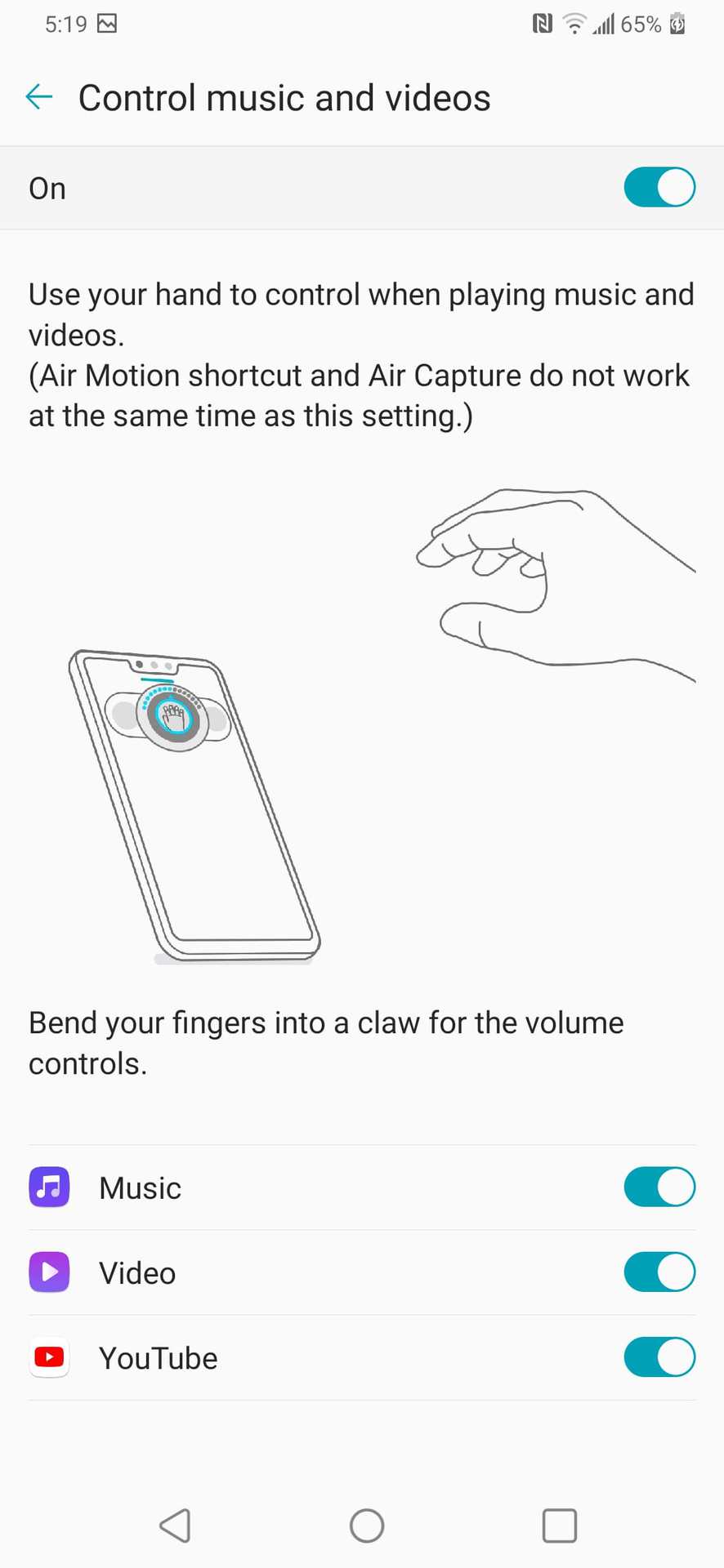
Control music and videos

This makes it possible to control your music and videos when in supported apps.

  • Open the Settings app.
  • Hit the "General" tab.
  • Select "Air Motion".
  • Toggle "Control music and videos" on.
  • Hit "Control music and videos" to access more specific options.
  • Towards the bottom of the options you can select which apps you want Air Motion to work with.
  • Once set up, simply open one of your supported apps.
  • Activate Air Motion by placing your palm, 2-5 inches over the front sensors. Your hand will be recognized and a light bar will show up right under the notch.
  • You can now pull your hand away until it is 6-8 inches away from the sensors. Form a claw with your fingers.
  • Swipe left or right to pause or play.
  • Turn your wrist left or right to control volume (as if you were turning an imaginary knob).

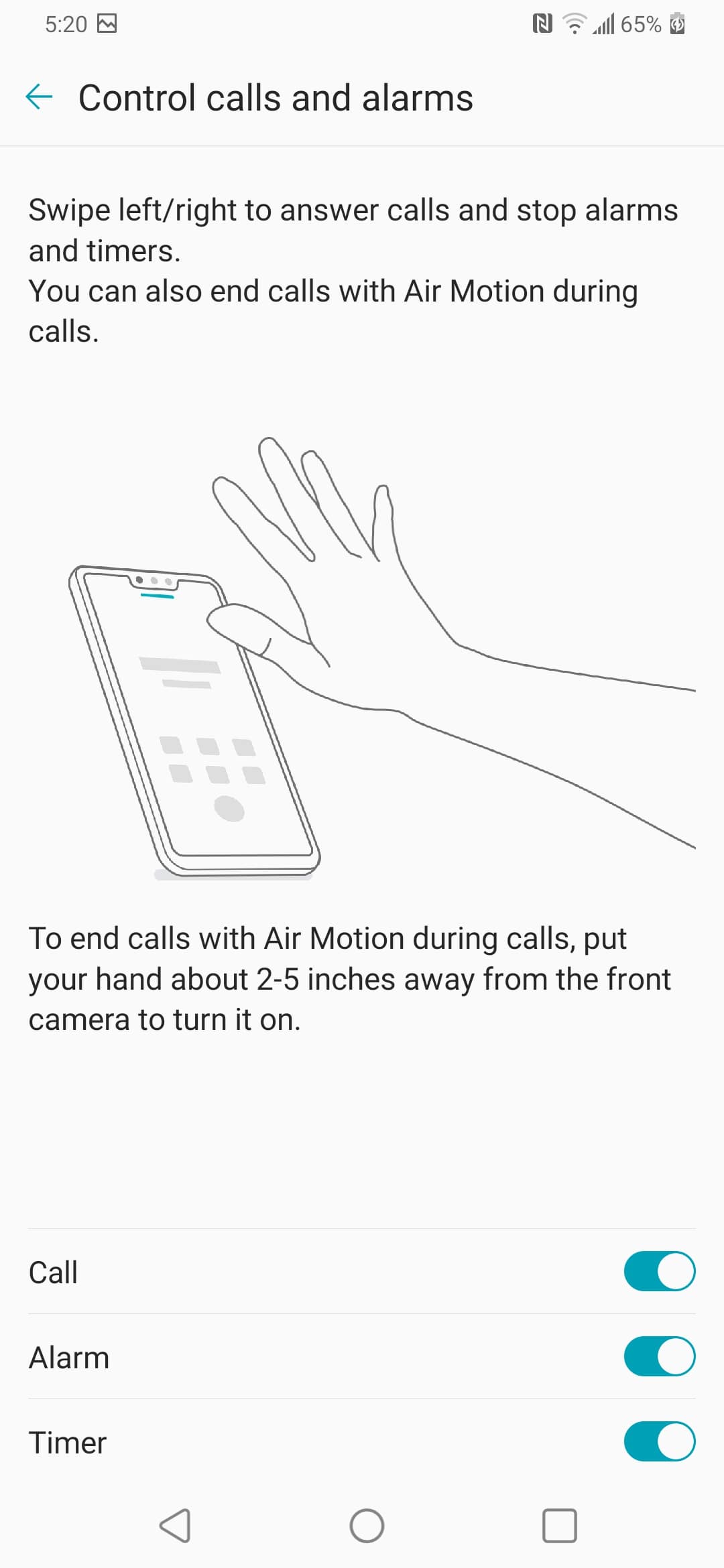
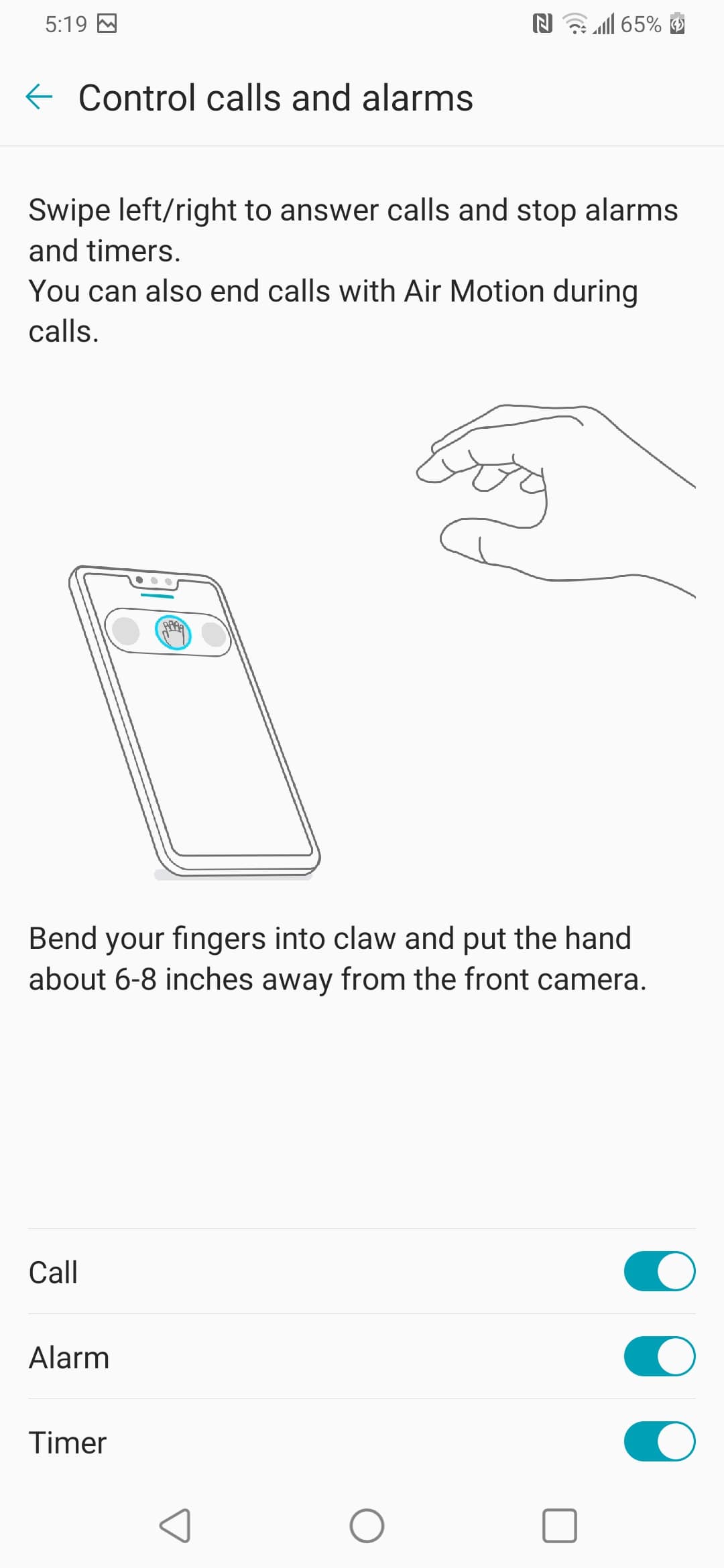
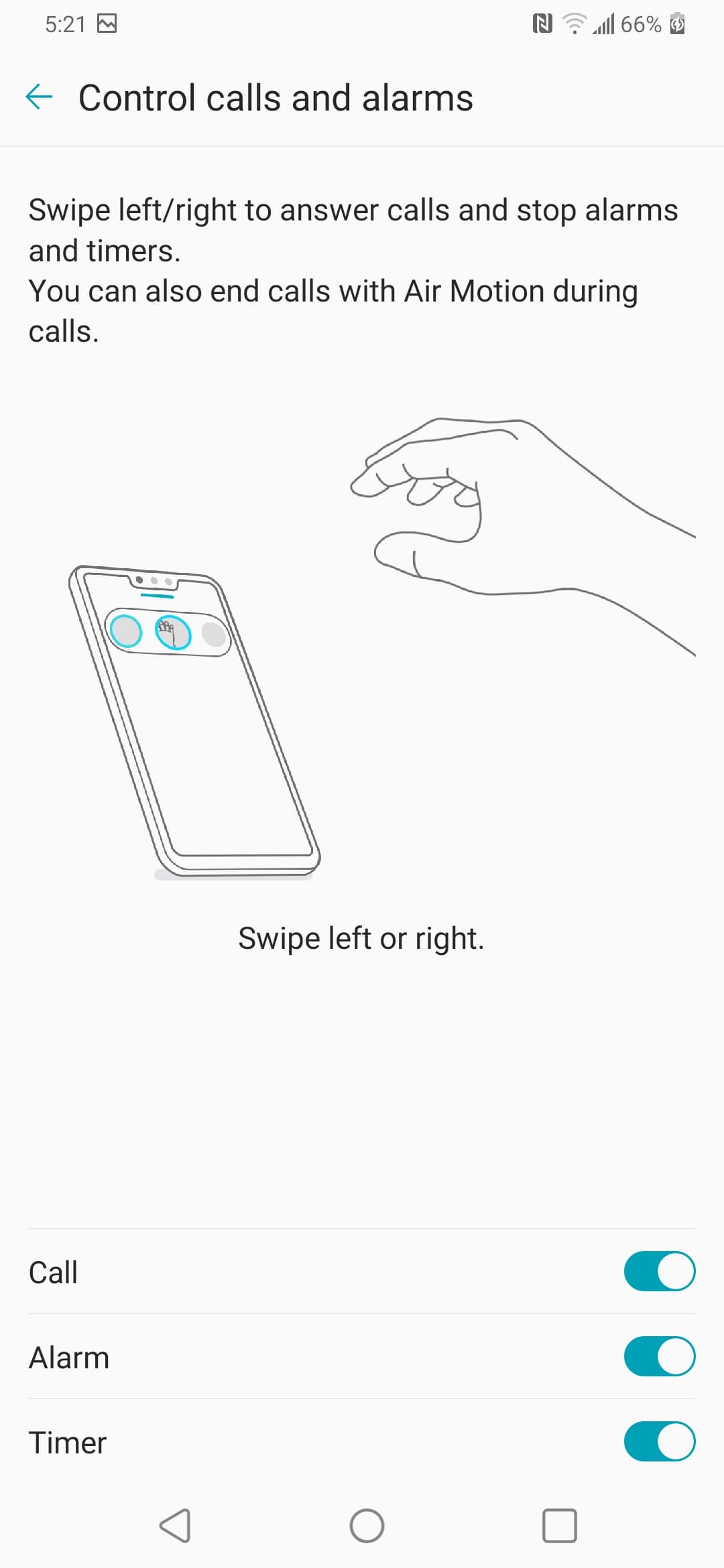
Control calls and alarms

  • Open the Settings app.
  • Hit the "General" tab.
  • Select "Air Motion".
  • Toggle "Control calls and alarms" on.
  • Towards the bottom you can select which actions you want Air Motion to work with. I have turned them all on just to have the option available when/if I need it.
  • When receiving a call, trying to end a call, or wanting to stop an alarm, simply activate Air Motion by placing your palm, 2-5 inches over the front sensors. Your hand will be recognized and a light bar will show up right under the notch.
  • You can now pull your hand away until it is 6-8 inches away from the sensors. Form a claw with your fingers.
  • Swipe left or right to answer calls, end calls, stop alarms, or end timers.

Wrapping up

An LG G8 teaser. LG

Air Motion features aren't for everyone, but we know they could be useful to some of you. For example, those of us who like to cook will know how often we have to operate our phones with dirty hands. This will no longer be an issue if you own the LG G8 ThinQ!

Hit the comments to let us know if Air Motion is a feature that would make a difference in your life. In which situations would you like to use it?

More LG G8 ThinQ content:


from Android Authority http://bit.ly/2J5hmts
via IFTTT