mercredi 1 mai 2019

New Wear OS Tiles feature gives you easy access to the info you need most

google wear os tiles demo on fossil sport

Wear OS has gone through many iterations — including a name change — since its launch, the most drastic of which rolled out in September 2018. Google isn't trying to reinvent the wheel with the launch of its new Tiles feature, but it does hope to make navigating around the smartwatch OS a little easier.

Further reading

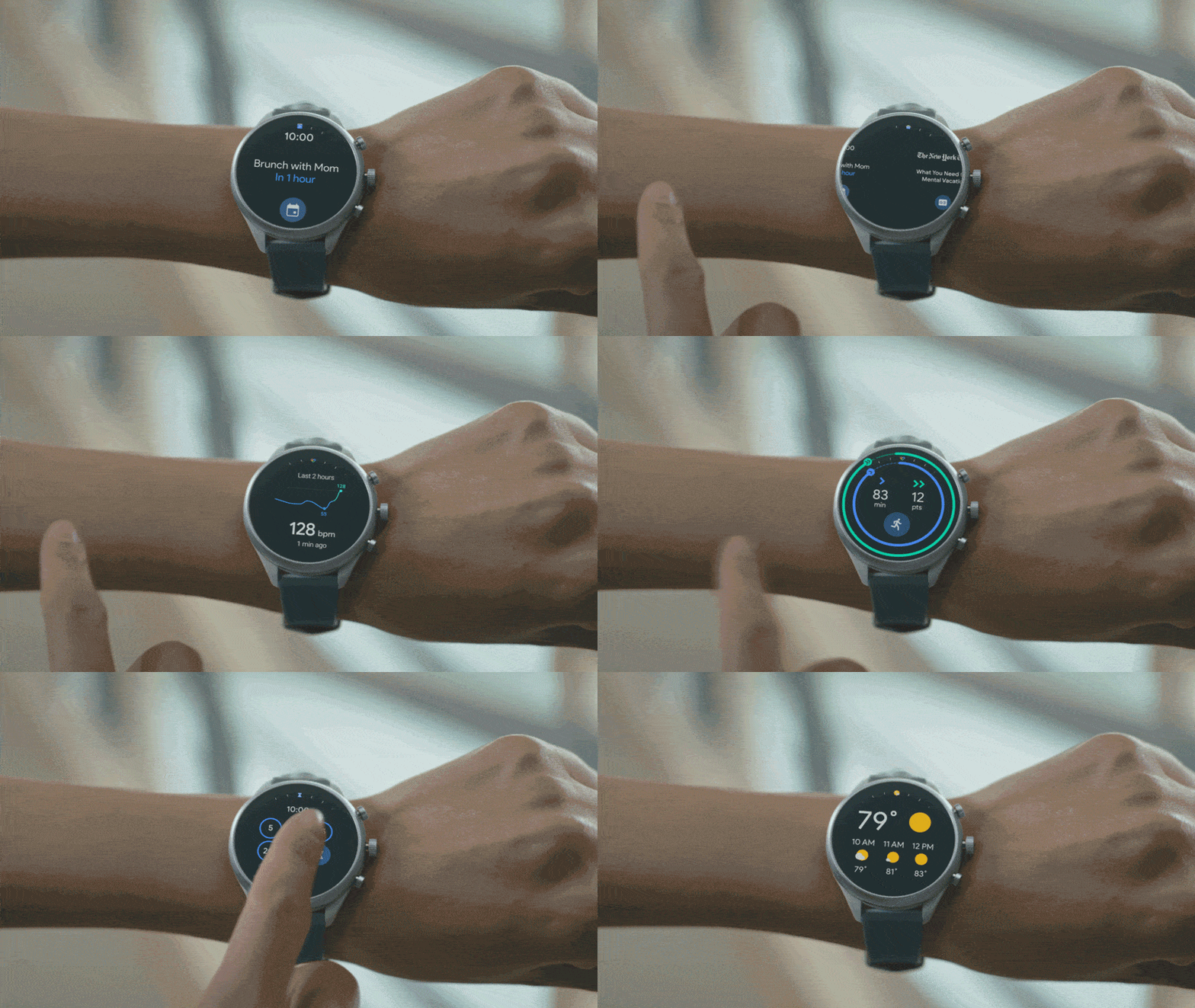
A big gripe with navigating around Wear OS is if you want to launch an app that's not the Google Assistant or Google Fit, you need you open the app drawer, scroll down to your app, and tap on it. This can be tedious on a smartwatch. Now, Google is adding something called Tiles that will give you swipeable access to the features most important to you.

Google is introducing six Tiles to Wear OS at the start: goals, next event, forecast, heart rate, headlines, and timer. Once the Tiles are added to your watch, a swipe left will allow you to scroll through each one for quick access to the information in each app. So, instead of navigating to your app drawer and manually launching the Timer app, a simple swipe over to the Tile is all you need.

Google says more Wear OS Tiles will be added in the future.

It's pretty easy to add and rearrange Tiles on your smartwatch — just tap and hold a Tile to move it around, or tap and drag one inside the Wear OS app.

The Tiles feature will roll out to Wear OS devices over the next month, but Google notes that "certain features will vary by phone OS, watch, or country."

We haven't had the chance to try out Tiles yet, but the feature will be on display in the Android Sandbox at Google I/O 2019. Android Authority will be in Mountain View covering the developer conference May 7-9, so stay tuned for more Google coverage.

Next: Google I/O 2019: What to expect


from Android Authority http://bit.ly/2vw27C3
via IFTTT

The Instagram Stories camera is getting a significant redesign and more

If you're a loyal user of Instagram Stories, you know that the user interface has not changed much since the feature was launched. Well, that will soon be changing as the company has announced a significant redesign.

As seen in the below screenshots, Stories will switch up the layout of the Stories' camera app. Everything from creative shooting modes such as Boomerangs to an ever-growing list of filters can be accessed through a carousel of sorts. 

Additionally, Instagram will soon release a new Create mode. This will allow users to share image- and video-free content with their followers on Stories. Create will show up alongside Live and Camera as a separate section from the 

Instagram Stories Camera and Create Mode Instagram

One feature that Instagram is rolling out today is a new Donation Sticker. As the name implies, users can use their followers to help raise money for several charities. All they need to do is select the sticker from the Stories panel, choose the non-profit they wish to support, and share the photo or video with their followers.

Instagram states that 100 percent of the money raised through the sticker will go to the selected charity.

Editor's Pick

Lastly, Instagram is also expanding its "Checkout" feature from Stories to the feed. Now, instead of just brands being able to promote and sell its products to users, influencers will be able to tag products from companies participating in the Checkout beta. 

Fifty five brands and influencers will be the first to try out Instagram's new Checkout features. If you come across one of these posts, you will be able to tap on one of the tagged products, view its listing, and complete your purchase all without leaving the social media app.


Previous Instagram updates

Instagram Checkout lets you buy things without leaving the app

March 19, 2019: Launched as a closed beta, "Checkout on Instagram" allows brands and companies to sell products through the social network. After clicking on the button, users will be able to complete the purchase without ever leaving the app. 

Only a few brands are signed up for now, but this will no doubt increase as the feature rolls out proper. You can see a list of all the brands on the Instagram blog here.

New Sticker features for Stories and Instagram Live

December 18, 2018: Instagram now lets users respond to question stickers in Stories with music tracks. As well as question stickers for comments on Instagram Live, countdown stickers have also been added to Stories.

Voice messaging

December 11, 2018: Instagram added a new voice messaging feature that works very similarly to voice messaging in Facebook Messenger, WhatsApp, and Apple's Messages app.

The feature is easy enough to trigger — just tap and hold the microphone button when in Instagram Direct to record your voice message. You can record a voice message up to one minute in length and remains in your Instagram Direct threads indefinitely.

Nametags and school communities

October 5, 2018: Instagram introduced Nametags. Likely inspired by Snapchat's Snap Codes, Nametags display a scannable area that includes your username. The idea is to forgo searching for people and just scan their Nametags instead.

Instagram also introduced school-specific communities for current and former college students. You can add your school and graduation year to your profile, as well as any school-based organizations you might be a part of.

Once you add a school, you become part of the university's directory on Instagram. You and other students can then search profiles based on class year.

Support for video chat, revamped Explore page, and new camera effects

June 26, 2018: Instagram introduced real-time video chatting within Instagram Direct. To start a video chat, go to the Direct tab, open a message thread, and tap the camera icon in the right corner. You can video chat with one friend or with a group of four people at a time.

Next up is the refreshed Explore page that includes new topic channels. When you open the Explore page, you now see a tray at the top with several personalized channels, such as art, sports, beauty, fashion, and "For You." Each channel includes posts for that specific topic.

Finally, the new camera effects feature designs from Ariana Grande, Buzzfeed, Liza Koshy, Baby Ariel, and the NBA. You will have to follow any of those accounts to get the corresponding camera effects, however.


More Instagram content:


from Android Authority http://bit.ly/2y25W5A
via IFTTT

Developers can start developing apps for Android Automotive at I/O 2019

Android Automotive OS in Polestar 2 Google

Google I/O 2019 is less than a week away, but that is not stopping the Silicon Valley company from giving us a peek into what's to come. First up, Google plans to open up media app development for the Android Automotive OS.

We have seen tidbits of the Automotive OS for over a year, with several cars running a beta version of the firmware at last year's developer conference. With vehicles such as the Polestar 2 coming to market soon, Google is finally getting developers ready for the new platform.

To do this, Google is expanding the Android Auto framework to help developers work with a variety of screen sizes, input methods, OEM customizations, and regional driver safety guidelines.

Google provided us with the below examples of how media apps will look on Android Automotive displays.

Android Automotive OS Media App UX Google

Just like with Android Auto as we know it, Google will soon allow developers to create apps that go beyond media consumption. The search giant has not announced when it will open these areas up, but it has plans to enable navigation and communication app development soon.

Editor's Pick

Google will spend a decent amount of time at I/O '19 helping developers build apps for this new automotive environment. In addition to hosting a "How to build Android apps for cars" session at the developer conference, the Android Automotive team will be hosting office hours and app reviews.

Developers at I/O 2019 can then beta test their apps on reference units like the one seen below at the festival's codelabs area.

Android Automotive OS Reference Unit Google

You can read Google's full announcement here. Developers interested in developing for Android Automotive OS can join the new Google Groups community and StackOverflow.


from Android Authority http://bit.ly/2H1wGoz
via IFTTT

Google Pixel 3a and Pixel 3a XL: Everything we know so far (Updated: May 1)

Photo of the speculated Google Pixel 3 Lite/Pixel 3 XL Lite held in a hand with the screen turned on. Rozetked

Update, May 1, 2019 (12:15 PM ET): As excitement ramps up for Google I/O 2019, we now have leaked box art for the Pixel 3a and 3a XL as well as some hints about the India launch. Read below for more!


Original article, February 8, 2019 (10:30 AM ET): While there has been speculation for years about Google launching more affordable versions of its high-end Pixel smartphones, it appears the company is now actively developing two such handsets, and they could launch soon. These phones will reportedly be branded the Google Pixel 3 Lite and Google Pixel 3 XL Lite, or the Google Pixel 3a and 3a XL (we use both throughout this article), and are tipped to include the same great camera hardware as the standard Pixel 3 phones.

Editor's Pick

Here's a look at everything we know so far about the Google Pixel 3a and Pixel 3a XL. Keep in mind that Google has not confirmed it is even working on these phones, so treat these rumors with caution. We will update this article as more reliable reports about these phones are published.

Google Pixel 3a and Pixel 3a XL: Release date and price

Photo of the backside of a blue Google Pixel 3 Lite Rozetked

In February, the Federal Communications Commission (FCC) listed two unannounced Google phones with model numbers G020C and G020G: these are likely to be the Pixel 3 Lite and Pixel 3 XL Lite.

Meanwhile, news from Android Police in December suggested these phones would launch sometime this spring — a claim that has some clout, according to a later 9to5Google story.

On April 15, Google posted a teaser image that heavily suggests we'll see the Google Pixel 3a and 3a XL debut at Google I/O 2019 during the keynote address. If this is true, we'll get our first official look at the devices on May 7.

We once again saw that May 7 date on renders that serial tipster Evan Blass leaked April 24. In the renders, the Pixel 3a shows May 7 as the date. That's not confirmation that Google will announce the new Pixel phones May 7, but that's twice that we've seen the same date.

Additionally, we have an official teaser from Google on Flipkart that strongly suggests the Pixel 3a lineup will land in India on May 8. Considering the Google keynote address in California at I/O 2019 starts at 10:30 PM India time on May 7, a May 8 release date makes sense.

Android Police also claimed, like all the previous Pixel phones, the Lite handsets will be sold through Verizon Wireless in the U.S. However, at this stage, it's not clear if Verizon will be the exclusive U.S. carrier, as it has been for all the previous Pixel phone launches. There's a very credible rumor that T-Mobile will also sell the Pixel 3a lineup.

It's also very likely Google itself will sell both phones as unlocked devices directly from the Google Store and from its Google Fi network.

There's been no official word on what the prices will be like for the Pixel 3a and Pixel 3a XL, although the Russian site Rozetked claims the cost will be between $400 and $500. Meanwhile, leaked pricing (via Android Police) corroborates that estimate and suggests the Pixel 3a will cost $399 and the 3a XL will cost $479 in the U.S.

Keep in mind the standard Google Pixel 3 starts at $799, so we can expect the Lite models to be much less than that when they are first introduced.

Google Pixel 3a and Pixel 3a XL: Hardware specs

Photo of the speculated Google Pixel 3 Lite/Pixel 3 XL with 3.5mm audio cable connected to the headphone jack. Rozetked

According to Rozetked, which first leaked images of an alleged Google Pixel 3 Lite prototype in November 2018, the standard version will have a 5.56-inch IPS LCD display, with a 2,220 x 1,080 resolution. Leaked images of the prototype also show no notch on the display.

A reliable 9to5Google source also indicated the display would be 5.6 inches at a resolution of 2,220 × 1,080 (440dpi) but suggested it would be an OLED panel rather than LCD. LCD was previously suspected to be utilized as a cost-cutting measure.

Both 9to5Google and Rozetked suggest the Google Pixel 3a will have an octa-core Qualcomm Snapdragon 670 chipset — a downgrade compared to the much faster Snapdragon 845 chip found on the current Pixel 3 devices — and 4GB of RAM (the same as the standard Pixel 3 phones). However, the internal storage has allegedly been reduced to 32GB for the Lite models as opposed to the 64GB and 128GB storage amounts on the current Pixel 3 models, said Rozetked. 9to5Google's Stephen Hall seems to disagree, suggesting on Twitter there would only be 64GB Pixel 3a and 3a XL models. WinFuture also backs up this claim.

In April, 9to5Google spotted listings for two new phones on the Google Play Developer Console which back up some of these rumors. According to those listings, the "3a" naming scheme will be utilized for these new phones and they will both come with 4GB of RAM and screen resolutions of 2,160 x 1,080 for the 3a and 2,220 x 1,080 for the 3a XL.

As for the Pixel 3a battery size, this is said to be either 2,915mAh or 3,000maAh, according to the rumors.

On May 1, a leak of what appears to be the box art for the Pixel 3a corroborated many of these spec rumors (via This is Tech Today):

This Is Tech Today

Editor's Pick

The most interesting thing about the Pixel 3a reports is that the camera hardware is said to be almost exactly the same as what's found on the current Pixel 3 phones. The rumors claim it will have the same 12MP single rear camera and just one 8MP front-facing camera. That selfie camera will still have the same specs as the Pixel 3's front camera, which has two of those same sensors. 9to5Google suggests the Pixel 3a camera app will have poorer performance (perhaps owing to the weaker processor), despite equal image quality, though.

If these reports are indeed accurate, that could be the biggest selling point of the Lite versions, as consumers would not have to pay a ton of money to get almost the same great camera experience.

Google Pixel 3 Lite photo sample of a road in dayligh conditions. Rozetked

Google Pixel 3 Lite photo sample of a bowl with oranges in indoor poor light conditions Rozetked

Rozetked also posted photo samples taken with the Pixel 3 Lite prototype. One shows an outdoor scene on a winter road in the daytime, while the other is supposed to be an example of the camera's portrait mode, with images of fruit. Unfortunately, we didn't get to see any comparison images with a standard Pixel 3 camera. The samples also didn't include an example of how the Lite camera could handle the Pixel 3's Night Sight mode, which offers great photos in low-light conditions.

Photo of the headphone jack on the new Google Pixel 3 Lite and Pixel 3 XL Rozetked

There's isn't a lot of information on the Pixel 3a XL yet, although it's likely that it could share some of the same specs as its smaller model, including the same processor, memory, storage and camera options. This phone would likely have a 6-inch display and a Full HD+ resolution, and we can expect a bigger battery than the standard model too, given the larger body. 91Mobiles and OnLeaks have previously posted what they claim are renders of the Pixel 3 XL Lite.

It's pretty much a given that both devices will launch with Android 9 Pie.

Google Pixel 3a and Pixel 3a XL: Design

One of the biggest design differences we expect for the Google Pixel 3a and 3a XL is that the devices will be made of plastic rather than the all-glass materials of the main Pixel 3 line. This is likely a cost-cutting measure.

From rumors leaked by WinFuture, we also expect the Lite devices to come in the traditional black color and white color that the main Pixel 3 line does. However, there could be a color called "Iris," which would likely be a purple or blue color to match the flower of the same name.

One small but important difference between the Pixel 3 Lite and the Pixel 3 is that it reportedly includes an old fashioned 3.5mm headphone jack on top. This will likely please a lot of folks who want to keep using their wired headphones and earbuds. On the downside, the phone is not supposed to have the dual front-facing speakers found on the current Pixel 3 phones, as the earpiece also serves as its single speaker.

On April 18, Android Headlines revealed what it claims are official renders of both the Pixel 3a and Pixel 3a XL. You can see those render below:

Alleged official renders of the Google Pixel 3 a and Google Pixel 3a XL. Android Headlines

It's hard to tell, but the 3a is on the left and the 3a XL is on the right. If you look closely, you can see that the 3a is slightly thinner than the 3a XL.

Serial tipster Evan Blass gave us clearer looks at the Pixel 3a and 3a XL on April 24 and 25. The renders even show off the Pixel 3a in a new purple color and with a highlighter green power button. You can check out the renders below.

Google Pixel 3a and Pixel 3a XL: Who are these phones for?

The back of the Google Pixel 3 Lite. Andro News

The biggest question surrounding the Google Pixel 3a and Pixel 3a XL may not be their hardware specs, their release dates, or their prices. Indeed, the big question about these phones may be who is the audience for these devices. If Google does launch these phones in May, they will be the first mid-range handsets from the company since it released the Nexus 5X way back in 2015.

One group of consumers who might be the target of the Pixel 3 Lite are people who have read reviews of the Pixel 3's superior camera hardware but don't want to pay a ton of money to get the phone itself. Using lower-end materials and hardware specs while also keeping most of the camera specs intact on the Pixel 3 Lite could get more people to check out Google's products.

It's also possible Google wants to see Pixel phones sold in more countries, particularly markets like India where cheaper phones are more popular. Offering the Google Pixel 3a in those countries could be a good move, as reasonably-priced phones with good cameras may stand out among other mid-range handsets.

If you have any other information regarding the Pixel 3 Lite or Pixel 3 XL Lite, tip us!

NEXT: Did the Celeron version of the Google Pixel Slate go to tablet purgatory?


from Android Authority http://bit.ly/2tkufXD
via IFTTT
LG earnings report suggests the company needs a hit phone fast

South Korean electronics giant LG just posted its earnings report for the first quarter of 2019. Although the company's home appliance division saw record growth as compared to this time last year, its mobile division continues to lose the company huge amounts of money.

LG reported mobile division sales of 1.51 trillion South Korean won (~$1.34 billion) with a quarterly operating loss of 203.5 billion KRW (~$181.05 million). Although this represents a slight improvement as compared to the previous quarter (Q4 2018), the division is still bleeding cash and showing no growth.

Editor's Pick

Previously, LG's other divisions have been able to prop up the loss-leading mobile sector, but now things are getting to the point where even that is not possible. At this point, LG's overall business is sagging under the dead weight of its mobile division, which has been in the red now for nine straight quarters.

In LG's press release for the news, the company specifically mentions the upcoming LG V50 ThinQ, which will be the first 5G device from the manufacturer and only one of a handful of 5G devices on the market. After the mediocre reviews for the LG G8 ThinQ, LG makes it clear that it has a lot riding on the V50.

The press release also highlights LG's cost-cutting measure of moving mobile production from South Korea to its plant in Vietnam.

We'll have to wait for the next quarterly results to see if these strategies pan out for LG. Hopefully, something works for the company soon, as it won't be able to sustain losses like this for long.

NEXT: LG G8 ThinQ camera review: Average all around

Affiliate disclosure: We may receive compensation in connection with your purchase of products via links on this page. The compensation received will never influence the content, topics or posts made in this blog. See our disclosure policy for more details.


from Android Authority http://bit.ly/2GVarll
via IFTTT

Best Android phones (May 2019): Our picks, plus a giveaway!

One of the great things about the Android market is the diversity of features, prices, and even software. There are a ton of Android phones out there, but what's the best in 2019?

Related: Refurbished phone guide | Best Android tablets | Best Android watches

Spec sheets and feature lists aren't always enough to get an idea of how good a phone really is. In this roundup, we're looking at the absolute best — the Android phones of 2019 you can't go wrong with. We picked based on a combination of internal testing and subjective reviewing. Phones are judged by four main criteria: the best overall, best camera, best battery, and best value. Without further delay, here are the best Android phones!

Best Android phones update:May 2019
This month, we removed the Huawei Mate 20 Pro from our list to make room for the Huawei P30 Pro. The P30 Pro moved to our third-place spot, overtaking the Samsung Galaxy Note 9. We also added a new giveaway! Head to the bottom of the article for details on how to enter.

Before we dive in, here's a quick overview of the best Android phones for each category:

  • The best Android phones overall: Samsung Galaxy S10 Plus and Galaxy S10e, Google Pixel 3 and Pixel 3 XL, Huawei P30 Pro, Samsung Galaxy Note 9
  • The best camera phones: Huawei P30 Pro, Google Pixel 3 and Pixel 3 XL
  • Android phones with the best battery life: Huawei P30 Pro, Samsung Galaxy S10 Plus
  • The best value Android phones: OnePlus 6T, Honor View 20
  • Upcoming Android phones: LG V50 ThinQ, Sony Xperia 1, Samsung Galaxy S10 5G

Wondering why each of these Android phones came out on top in each of their respective categories? Read on to find out why we chose these Android phones for our list.


Samsung Galaxy S10 Plus and Galaxy S10e

Samsung's Galaxy S line reaches near perfection with the Samsung Galaxy S10 Plus. There's little this phone can't do. Featuring the Snapdragon 855 (or the Exynos 9820, depending on market), up to a massive 12GB of RAM, and a 6.4-inch AMOLED panel with the new Infinity-O punch hole, this is an attractive powerhouse. Its high-performance ethos continues on to the rest of the components including storage, which goes as high as 1TB, and a 4,100mAh battery that's more than capable of making it through the day.

The only weak link is the camera. The new camera package isn't bad, but it doesn't hold a candle to devices like the Pixel 3 or even Samsung's own Galaxy Note 9. Still, if you can look past that, the rest of the phone is amazing and there are few other phones out that that come close to offering this much under the hood.

If you don't need a giant phone and still want a similar Galaxy S10 experience, you should absolutely check out the Samsung Galaxy S10e. It's smaller, cheaper, and has a better fingerprint sensor!

What makes it "the best"

  • The S10 Plus is one of the best Android phones overall thanks to a great mix of features, performance, and beautiful design.
  • It's also one of the best phones for battery life with its massive 4,100mAh battery that's able to keep on going. 

Why you should buy

  • It has high-end hardware, a long-lasting battery, and a rich feature set.
  • It has the best display you can get on any smartphone.

Why you should pass

  • It's expensive.
  • The camera isn't quite as impressive as some of the other options on this list.

Learn more

Google Pixel 3 and Google Pixel 3 XL

While they may not rival the Galaxy S10 in terms of specs, the Google Pixel 3 and Pixel 3 XL improve on the very aspect that made the Pixel 2 so great — the camera. They still sport the same single rear cameras as the Pixel 2, but there are a ton of camera software improvements here. Top Shot mode will take multiple pictures of your subject and recommend the best one. Night Sight also brings next-level low-light photography thanks to computational photography. Finally, there's a mode called Motion Auto Focus that lets the Pixel 3 focus on a subject in a video, no matter how much they move around.

They both have 18:9 screens (well, 18.5:9 for the XL), yet they still look very different from one another. The Pixel 3 has a 5.5-inch Full HD+ screen that makes it look like a smaller Pixel 2 XL, while the Pixel 3 XL has a big ol' notch at the top of its screen. Both phones also come with Qi wireless charging support, no headphone jack (womp womp), and still manage to squeeze in front-facing speakers.

The Pixel 3 could be considered the Android iPhone. But is there anything wrong with that?

What makes it "the best"

  • One of the best Android phones overall thanks to snappy and responsive stock software, paired with the very best Android camera.
  • One of the best Android camera phones thanks to a combination of great camera software and a quality camera sensor. That's even more impressive considering its one of the few single-camera setups left on the market. 

Why you should get it

  • It takes great photos in all lighting conditions.
  • Speedy software updates come straight from Google.

Any reasons to pass?

  • They're both pricey.
  • Neither phone has a headphone jack.

Learn more

Huawei P30 Pro

The Google Pixel 3 might be the photography king, but not if Huawei has anything to say about it. The new Huawei P30 Pro packs a triple-camera setup — complete with a time-of-flight sensor — and brings one of the most versatile camera experiences out there. The 40MP main sensor, coupled with the 20MP wide-angle and 8MP telephoto lenses, aim to offer a solid photography experience whether you're shooting landscape or portrait photos.

This is all backed by a fantastic spec sheet, a striking design, and new hardware features that give other 2019 flagships a run for their money.

What makes it "the best"

  • One of the best Android phones overall thanks to powerful hardware, solid cameras, and a long-lasting battery.
  • The triple-camera setup is truly great.

Why you should get it

  • It has three extremely versatile cameras that rival the best out there.
  • The fast-charging battery also lasts a long time on a single charge.

Any reasons to pass?

  • It's expensive.
  • If you live in the U.S., you'll have to import one.
  • Huawei's software UI is not the best.

Read more

Samsung Galaxy Note 9

The Samsung Galaxy Note 9 is one of the best phones you can buy. It packs a big 6.4-inch Super AMOLED display that shows off video and image content to the highest degree. It's got a fast processor inside (either the Qualcomm Snapdragon 845 or the Samsung Exynos 9810). It has plenty of memory (6GB or 8GB of RAM) and tons of onboard storage (128GB or 512GB).

The Note 9's dual rear camera takes excellent pictures. The embedded S Pen has added functionality this time, including remote control support. Even the Note 9's battery gets an upgrade to 4,000mAh, which means you can work longer on a single charge. It may be expensive, but if you want one of the best all-around Android phones, the Samsung Galaxy Note 9 is hard to beat.

What makes it "the best"

  • One of the best Android phones overall thanks to a big screen, solid hardware and performance, and the included S-Pen for even more features.
  • One of the best Android camera phones thanks to its excellent rear cameras that take great photos.

Why you should buy

Why you should pass

  • It's expensive.

Learn more

OnePlus 6T

What if you could get nearly every feature you'd expect from a high-end flagship phone, but without having to shell out $1,000? You can, thanks to the OnePlus 6T. You get a fast processor — the Snapdragon 845 — plenty of RAM, lots of storage, and a large 6.41-inch Super AMOLED display with a small waterdrop notch.

You even get something not all smartphones have: an in-display fingerprint sensor.

The 3,700mAh battery lasts over a day, and it's backed up by the company's fast charging technology, which will fully charge it up in less than 90 minutes. All that and it starts at just $549.

What makes it "the best"

  • One of the best value Android phones thanks to a reasonably low price tag while still featuring specs and a premium body that normally are found on high-end flagship phones that cost around $1,000.

Why you should get it

Any reasons to pass?

  • Cameras are not the best.
  • No headphone jack, which is a step backwards from the OnePlus 6.

Learn more

Honor View 20

The Honor View 20 has a lot of the same hardware specs as the more expensive Huawei Mate 20 Pro. The Honor View 20 has a Kirin 980 processor inside, and you can get it with 6 or 8GB of RAM and either 128GB or 256GB of onboard storage. This phone's 4,000mAh battery will last you around two full days on a single charge. You also get a 40MP main rear camera combined with a 3D ToF sensor and a front-facing 25MP camera with a punch-hole design. The Honor View 20 is also much cheaper than the Mate 20 Pro, though still a bit steep.

What makes it "the best"

  • One of the best value Android phones thanks to hardware that is on a par with the Mate 20 Pro for far less money.

Why you should get it

  • Some of the same hardware as the Mate 20 Pro for a lower price.
  • Punch-hole front-facing camera is arguably nicer looking than a notch.

Any reasons to pass?

  • Still might be too pricey for many people.
  • Hard to find support in the U.S.

Read more

Upcoming Android phones

That's the best so far, but there are certainly several other handsets on the way that might be worth checking out. Here's our list of upcoming handsets to keep an eye out for.

LG V50 ThinQ 5G

The LG V50 ThinQ 5G will be the company's first 5G phone when it launches later this year. It's also likely to be one of the first standalone 5G phones to come to market, if not the very first — if you are lucky enough to live in an area where the cell networks will support it.

Sony Xperia 1

Sony wants to get people re-interested in its Xperia phones with this latest release, due out later in 2019. The Xperia 1 has a 6.5-inch screen with a tall 21:9 aspect ratio. It'll also be powered by the latest Qualcomm Snapdragon 855 SoC.

Samsung Galaxy S10 5G

Samsung Galaxy S10 5G display

Even if you don't live in a 5G network area, you might want to get the Samsung Galaxy S10 5G when it launches later this year. It will have a truly huge 6.7-inch display, tons of RAM, and an even bigger battery than the S10 Plus. Just be prepared for a very large price tag.


That's it for our list of the best Android phones you can buy, but it's only a fraction of what's out there. If you're a gamer you might want to consider a gaming phone. Budget shoppers will want to check out our guide to the best cheap Android phones. Want to know what your carrier is offering? Check out our guides to the best Verizon phones, best AT&T phones, best Sprint, and best T-Mobile Android phones.

Now it's time for you to speak up! Cast your vote below for what you think is the best Android phone, and enter this month's giveaway for your chance to win the top-voted phone throughout the month of May. Good luck!

Congratulations to the best Android phones (April 2019) giveaway winner, Ben T. from Australia. You won a brand new Samsung Galaxy S10 Plus!

Best Android phones (May 2019) international giveaway

That's all, folks. What are your thoughts? Be sure to leave a comment below if you feel strongly about any one of these phones?


from Android Authority http://bit.ly/2gaB737
via IFTTT

12 things you need to know in tech today

Here's your daily tech digest, by way of the DGiT Daily newsletter, for Wednesday, May 1, 2019!

Like what you're reading? Then you can also subscribe and get the newsletter sent directly to your inbox — check out the box at the bottom of the page.

1. A brand new Facebook

Facebook CEO Mark Zuckerberg at Facebook's F8 Conference 2019. Facebook

Mark Zuckerberg kicked off the first day of Facebook's F8 2019 conference yesterday. The two-day event brings together Facebook developers and creators to discuss current and future products. It's also where Facebook reveals its company aims for the year ahead, and in 2019, that focus is privacy.

(Quick fact: In German, "Zucker" is "sugar" and "Berg" is "mountain." Guys, he's Mark Sugarmountain in Germany!)

Privacy

  • In his keynote speech opening, Zuckerberg confessed, through laughter, "I know we don't have the strongest reputation on privacy right now, to put it lightly."
  • Facebook has been hit by a string of privacy scandals in the recent past (Wired).
  • But the CEO declared "the future is private," and outlined several steps Facebook was taking to ensure its platform delivers this.
  • Facebook will take "a more proactive role in making sure that all of our partners and developers use our services for good" — great to hear.
  • It's also "Replumbing" Facebook's technical infrastructure to support the new privacy vision. Again, great to hear, and best of luck with that.
  • Further, Facebook noted it was working on "reduced permanence," i.e. ways to avoid permanent records of everything people do on the site, and "secure data storage" in the pursuit of greater privacy.

As well as internal company changes, Facebook is making changes to its product portfolio too. Some concerned with privacy, others not so much.

A screenshot of the new white Facebook design for desktop. Facebook

Facebook:

  • Facebook is dropping its classic blue stylings. In a new redesign, Facebook will implement a white, more iOS-like color scheme without the typical blue highlights. Facebook's iconic, erm, icon, will keep its color, though.
  • With the new design comes a greater emphasis on "communities." This means you'll getting redesigned groups tab making them easier to participate in, and a more personalized news feed. (Android Authority). The Android and iOS apps will reflect the change from today while the browser version will be upgraded in the coming months.

Secret Crush:

  • "Secret Crush" is a new feature coming to Facebook via the Facebook Dating platform it has been developing (Android Authority). It's hitting The States later this year.
  • Secret Crush will allow a user to select up to nine Facebook contacts they have the hots for, notifying those users that *somebody* is into them. If that user also happens to select the same person as one of their secret crushes, a Messenger conversation will open to let them begin a dialogue. It's an opt-in feature.

Facebook Messenger:

  • Facebook Messenger is getting end-to-end encryption by default now — certainly a privacy win. Meanwhile, the company is also rebuilding the app to make it faster and lighter (Android Authority).
  • Facebook says it wants it to be the "fastest private communication app on the entire planet." (was Messenger ever slow?) It's also coming this year, along with a desktop version.

Instagram:

  • Facebook is trialing a "Hidden Likes" feature for Instagram. This would allow users to disable likes from being displayed on their images or videos, taking the focus away from popularity and back to the actual content.
  • The uploader will still be able to see the like count, however. It's being tested in Canada and will likely roll out elsewhere if it proves popular.

Facebook reaction emojis in a line on a phone.

A watershed moment for Facebook?

  • Facebook wants to regain user trust and it aims to do so with increased privacy measures: sensible!
  • Better still, there seems to be more behind this move than visible measures like enforced message encryption: it looks like this will run in the veins of the whole business.
  • But these are mostly just nice sentiments right now and its efforts will be hard to track. How will we know if the folks at Facebook HQ are taking privacy seriously?
  • We may see fewer scandals in the coming months — does that mean Facebook users are safer or that Facebook is getting better at disguising poor practices?
  • Ultimately, I can't imagine a time when Facebook won't rely on *some form* of data collection and sharing, but I'm hopeful it will become less of a concern over time. Don't forget corporations have used our data for decades but that doesn't mean it's always for ill (Business News Daily).
  • One thing that did rub me up the wrong way was Zuckerberg's "the future is private" remark, though. It's not like privacy became desirable only in the last year or two: it has always been a concern for humanity. Facebook just missed the memo.

For a broader overview of Facebook, Instagram, WhatsApp, Messenger, and AR/VR, check the highlights here (Facebook Newsroom). Or watch the keynote in 12 minutes thanks to this supercut (The Verge).


2. Alphabet announced board member Eric Schmidt will not seek re-election once his term ends on June 19, 2019. Schmidt served as Google CEO from 2001 to 2011 (Android Authority).


3. OnePlus shows off OnePlus 7 Pro camera samples (Android Authority).


4. Morbid study estimates more dead than living Facebook users by 2070. Some say its users are already zombies… (LiveScience).


5. BBC outlines some of the psychological tricks of airport design. Very interesting and a bit scary. "Some airports such as Gatwick and Heathrow only tell you which gate to go to 25 minutes before departure to maximize shopping time." I wonder if my recent flight delays were just a ploy to coax another Toblerone purchase out of me (BBC).


6. Apple is telling lawmakers people will hurt themselves if they try to fix iPhones (Motherboard).


7. Also on Apple: iPhone sales continue to slump as services surge (Tom's Guide).


8. Tesla sued over fatal 2018 Model X crash with Autopilot engaged (Engadget).


9. Oculus Rift S and Quest will launch next month and pre-orders are now open (Gamespot).


10. Valve's Index VR headset will officially cost $999, and here's what it's all about (The Verge).


11. Microsoft, Slack, Zoom, and the SaaS Opportunity (Stratechery). Some food-for-thought on how Microsoft last week (briefly) became "the third U.S. company, after Apple and Amazon, to achieve a market capitalization of over $1 trillion."


12. What is a true fact that sounds like a conspiracy theory? (r/askreddit).


DGiT Daily: Your Tech Resource

Dgit Daily is powered by our sister site dgit.com

Visit dgit Daily

Finally, a tech subscription worth reading.

Sign up for daily digests of the tech content most relevant to you.
By signing up, you agree to our Privacy Policy and European users agree to the data transfer policy.

In case you don't know, the DGiT Daily delivers a daily email that keeps you ahead of the curve for all tech news, opinions, and links to what's going down in the planet's most important field. You get all the context and insight you need, and all with a touch of fun, and the daily fun element that you otherwise miss.


from Android Authority http://bit.ly/2GMWhRT
via IFTTT